Animals / Bird
Carrion crow
Corvus corone · Corvidae
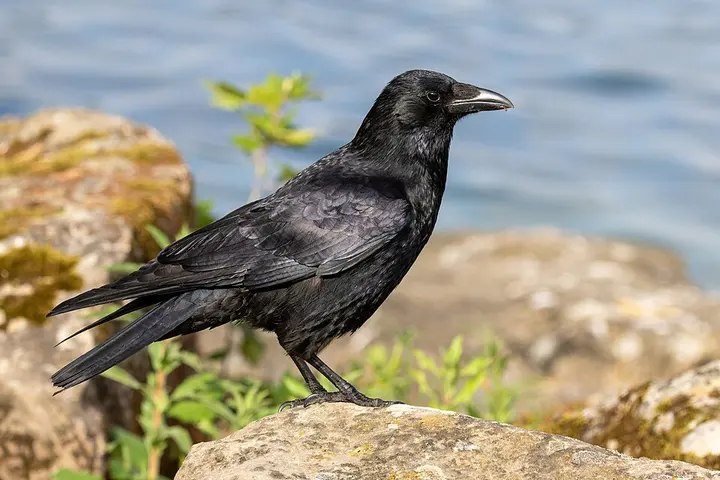
The carrion crow is a passerine bird of the family Corvidae, native to western Europe and the eastern Palearctic. Along with the hooded crow, the carrion crow occupies a similar ecological niche in Eurasia to the American crow in North America. The two species look very similar to one another, but can be differentiated by size, as the carrion crow is larger and of a stockier build compared to the American crow.
Appearance
The plumage of the carrion crow is black with a green or purple sheen, much greener than the gloss of the rook (Corvus frugilegus). The bill, legs, and feet are also black. It can be distinguished from the common raven by its size, around 48–52 cm (19–20 in) in length, as compared to an average of 63 cm (25 in) for ravens, and from the hooded crow by its black plumage. The carrion crow has a wingspan of 84–100 cm (33–39 in) and weighs 400–600 g (14–21 oz).
Behaviour
In distinguishing them, the rook is generally gregarious and the crow largely solitary, but rooks occasionally nest in isolated trees, and crows may feed with rooks; moreover, crows are often sociable in winter roosts. The most distinctive feature is the voice. The rook has a high-pitched kaaa, but the crow's guttural, slightly vibrant, deeper croaked kraa is distinct from any note of the rook.
Diet
Though an eater of carrion of all kinds, the carrion crow also eats insects, earthworms, other invertebrates, grain, fruits, seeds, nuts, small mammals, amphibians, fish, scraps of human food, and eggs it steals. Crows are scavengers by nature, which is why they tend to frequent sites inhabited by humans to feed on their household waste. Crows also harass birds of prey or even foxes for their kills.
Where the Carrion crow lives
Recorded in United Kingdom, France, Netherlands, Germany, Spain, Belgium, Portugal, Denmark and Japan (Europe and Asia).
Most records fall in Noord-Holland, Noord-Brabant, Zuid-Holland, Baden-Württemberg, Nordrhein-Westfalen and Bayern.
See the Carrion crow’s range on the globe
Conservation status
Least concern (LC). Not at risk: it is doing well in the wild. Categories are the IUCN Red List as republished by GBIF.
Sources
The range is a density of 5,830,406 georeferenced GBIF records, shown on the continents where it is mainly recorded, not an expert-drawn map. Description from Wikipedia.