Animals / Bird
Carolina wren
Thryothorus ludovicianus · Troglodytidae
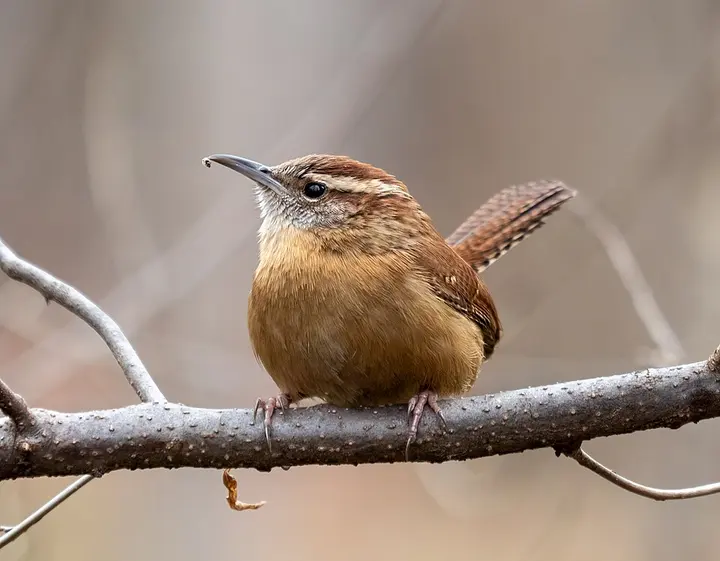
The Carolina wren is a species of wren common in the eastern United States, the extreme south of Ontario, Canada, the northeast and southeast of Mexico, and into northern Central America. Severe winters restrict the northern limits of their range, while favorable weather conditions lead to a northward extension of their breeding range. Their preferred habitat is in dense cover in forest, farm edges, and suburban areas.
This wren is the state bird of South Carolina. Ten subspecies are recognized, occurring across the range of the species; they differ slightly in song and appearance. It is generally inconspicuous, avoiding the open for extended periods of time. When out in the open, they energetically investigate their surroundings and are rarely stationary. After finding a mate, pairs maintain a territory and stay together for several years. Both males and females give out alarm calls, but only males sing to advertise territory. Carolina wrens raise multiple broods during the summer breeding season but can fall victim to brood parasitism by brown-headed cowbirds, among other species.
Appearance
At 12.5 to 14 cm (4.9 to 5.5 in) long, with a 29 cm (11 in) wingspan and a weight of about 18 to 23 g (0.63 to 0.81 oz), the Carolina wren is a fairly large wren; the second largest in the United States species after the cactus wren. Among standard measurements, the wing chord is 5.4 to 6.4 cm (2.1 to 2.5 in), the tail is 4.5 to 5.6 cm (1.8 to 2.2 in), the culmen is 1.4 to 1.8 cm (0.55 to 0.71 in) and the tarsus is 2 to 2.3 cm (0.79 to 0.91 in).
Behaviour
Carolina wrens sing year round and at any point during the daytime, except during the most harsh weather conditions. Males alone sing, and have a repertoire of at least twenty different phrase patterns and on average, thirty two. One of these patterns is repeated for several minutes, and although the male's song can be repeated up to twelve times, the general number of songs ranges from three to five times in repetition.
Diet
Carolina wrens spend the majority of their time on or near the ground searching for food, or in tangles of vegetation and vines. They also probe bark crevices on lower tree levels, or pick up leaf-litter in order to search for prey. Their diet consists of invertebrates, such as beetles, true bugs, grasshoppers, katydids, spiders, ants, bees, and wasps. Small lizards and tree frogs also make up the carnivorous portion of their diet.
Habitat
These birds are largely resident, and will only disperse beyond their range after mild winters. Carolina wrens sporadically breed as far north as Maine and Quebec after mild winters. In certain parts of their range, such as most of Iowa, prolonged periods of snow can curtail potential expansion.
Where the Carolina wren lives
Recorded in United States of America and Canada (North America).
Most records fall in Virginia, Texas, Pennsylvania, North Carolina, Florida and Maryland.
See the Carolina wren’s range on the globe
Conservation status
Least concern (LC). Not at risk: it is doing well in the wild. Categories are the IUCN Red List as republished by GBIF.
Sources
The range is a density of 12,921,245 georeferenced GBIF records, shown on the continents where it is mainly recorded, not an expert-drawn map. Description from Wikipedia.