Animals / Mammal
Caracal
Caracal caracal · Felidae
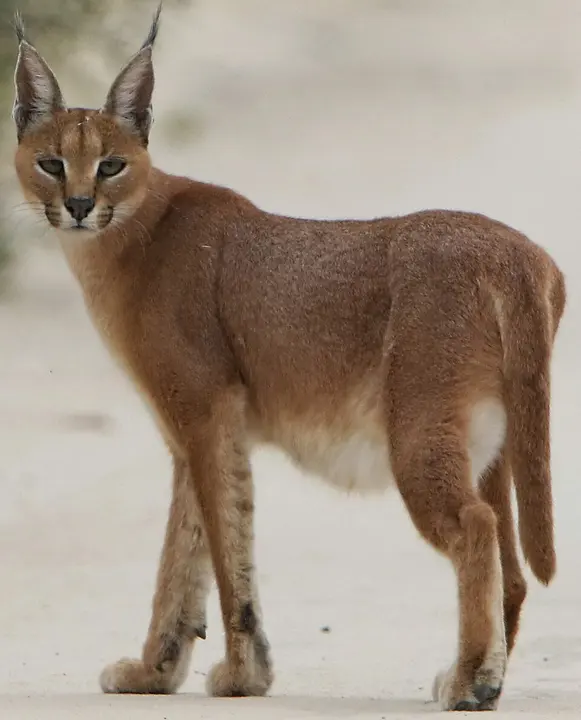
The caracal is a wild cat native to Africa, the Middle East, Central Asia, and arid areas of Pakistan and northwestern India. It is characterised by a robust build, long legs, a short face, long tufted ears, relatively short tail, and long canine teeth. Its coat is uniformly reddish tan or sandy, while the ventral parts are lighter with small reddish markings.
It reaches 40–50 cm (16–20 in) at the shoulder and weighs 8–19 kg (18–42 lb). It was first scientifically described by German naturalist Johann Christian Daniel von Schreber in 1776. Three subspecies are recognised. Typically nocturnal, the caracal is highly secretive and difficult to observe. It is territorial, and lives mainly alone or in pairs. The caracal is a carnivore that typically preys upon birds, rodents, and other small mammals. It can leap higher than 3.0 m (9.8 ft) and catch birds in midair. It stalks its prey until it is within 5 m (16 ft) of it, after which it runs it down and kills it with a bite to the throat or to the back of the neck. Both sexes become sexually mature by the time they are one year old and breed throughout the year.
Appearance
The caracal is a slender, moderately sized cat characterised by a robust build, a short face, long canine teeth, tufted ears, and long legs. It reaches nearly 40–50 cm (16–20 in) at the shoulder. The tan, bushy tail extends to the hocks. The caracal is sexually dimorphic; the females are smaller than the males in most bodily parameters.
Behaviour
The caracal is typically nocturnal, though some activity may be observed during the day as well. However, the cat is so secretive and difficult to observe that its activity at daytime might easily go unnoticed. A study in South Africa showed that caracals are most active when the air temperature drops below 20 °C (68 °F); activity typically ceases at higher temperatures.
Diet
The caracal typically preys on small mammals, which generally comprise at least 80% of its diet; and it also targets small Cercopithecidae monkeys and larger antelopes such as young kudu, impala, mountain gazelle, dorcas gazelle, Cape bushbuck, gerenuk, mountain reedbuck, Sharpe's grysbok and springbok. The remaining percentage is made up of lizards, snakes and insects. Rodents comprise a significant portion of its diet in western India.
Habitat
In Africa, the caracal is widely distributed south of the Sahara, but considered rare in North Africa. In Asia, it occurs from the Arabian Peninsula, Middle East, Turkmenistan, Uzbekistan to western India. It inhabits forests, savannas, marshy lowlands, semideserts, and scrub forests, but prefers dry areas with low rainfall and availability of cover. In montane habitats such as in the Ethiopian Highlands, it occurs up to an elevation of 3,000 m (9,800 ft).
Where the Caracal lives
Recorded in South Africa, Israel, Kenya, Zambia, Tanzania, Benin and Namibia (Africa and Asia).
Most records fall in Western Cape, HaDarom, Coast, Central, Northern Cape and HaZafon.
See the Caracal’s range on the globe
Conservation status
Least concern (LC). Not at risk: it is doing well in the wild. Categories are the IUCN Red List as republished by GBIF.
Sources
The range is a density of 2,499 georeferenced GBIF records, shown on the continents where it is mainly recorded, not an expert-drawn map. Description from Wikipedia.