Animals / Mammal
Capybara
Hydrochoerus hydrochaeris · Caviidae
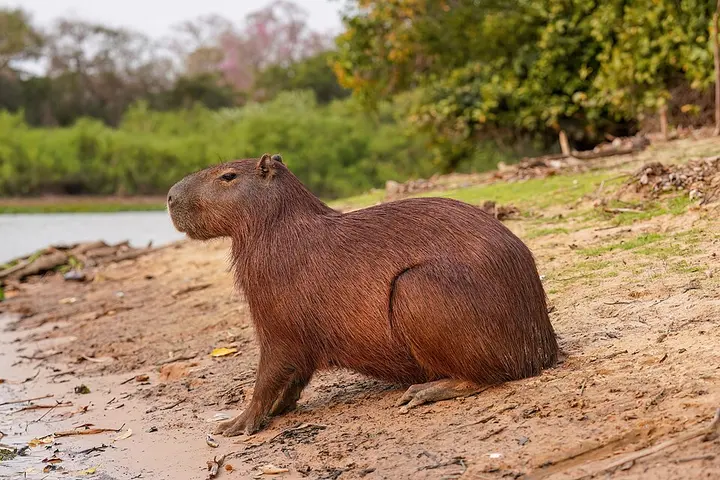
The capybara or greater capybara is the largest living rodent, native to all countries in South America except Chile. It is a semiaquatic herbivore that inhabits savannas and dense forests, living near and in bodies of freshwater and feeding mainly on grasses and aquatic plants.
Together with the lesser capybara, it constitutes the genus Hydrochoerus. Its other close relatives include guinea pigs and rock cavies, and it is more distantly related to the agouti, the chinchilla, and the nutria. The capybara is a highly social species that usually lives in groups of 10–20 individuals, but can be found in groups as large as 100. It is hunted for its meat and hide and for grease from its thick fatty skin.
Appearance
The capybara has a heavy, barrel-shaped body and a broad head, with reddish-brown fur on the upper part of its body that turns yellowish-brown underneath. Its sweat glands can be found in the surface of the hairy portions of its skin, an unusual trait among rodents. Its coarse fur ranges in length from 30 to 120mm.
Behaviour
Capybaras are found in all countries in South America except Chile. They are semiaquatic and live near bodies of freshwater, including rivers, lakes, ponds, streams, swamps and reservoirs. They are found in habitats such as seasonally flooded savannas, wetlands, and gallery forests, and along rivers in tropical rainforests. Capybaras live mostly in lowlands, and the highest elevation they have been recorded at is 1500m, in the Chapada dos Veadeiros National Park.
Diet
Capybaras are herbivores, grazing mainly on grasses and aquatic plants, as well as fruit and tree bark. They are very selective feeders and feed on the leaves of one species and disregard other species surrounding it. They eat a greater variety of plants during the dry season, as fewer plants are available. While they eat grass during the wet season, they have to switch to more abundant reeds during the dry season.
Life cycle
When in estrus, the female's scent changes subtly and nearby males begin pursuit. In addition, a female alerts males she is in estrus by whistling through her nose. During mating, the female has the advantage and mating choice. Capybaras mate only in water, and if a female does not want to mate with a certain male, she either submerges or leaves the water.
Where the Capybara lives
Recorded in Brazil, Colombia, Argentina, Bolivia and Peru (South America).
Most records fall in São Paulo, Santander, Casanare, Mato Grosso do Sul, Mato Grosso and Corrientes.
See the Capybara’s range on the globe
Conservation status
Least concern (LC). Not at risk: it is doing well in the wild. Categories are the IUCN Red List as republished by GBIF.
Sources
The range is a density of 26,699 georeferenced GBIF records, shown on the continents where it is mainly recorded, not an expert-drawn map. Description from Wikipedia.