Animals / Mammal
Cape porcupine
Hystrix africaeaustralis · Hystricidae
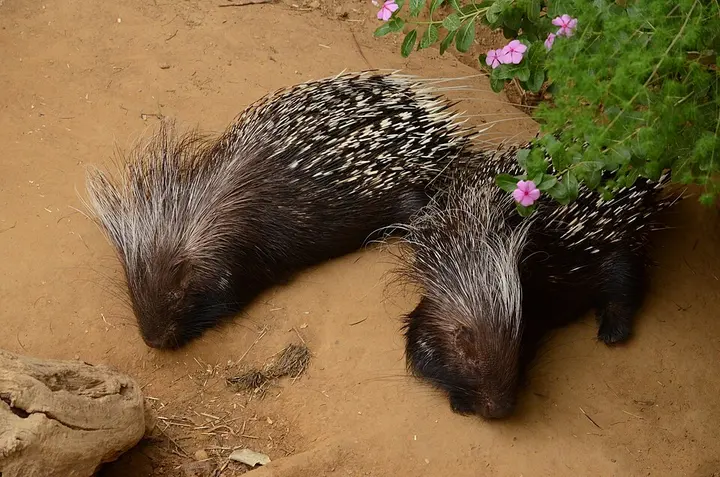
The Cape porcupine, Cape crested porcupine or South African porcupine, is a species of Old World porcupine native to central and southern Africa.
Appearance
Cape porcupines are one of the largest rodents in Africa and also one of the largest species of porcupine. Cape porcupines are amongst the largest living rodents in the world; a few other rodents appear to be larger in body mass such as the capybara and the Eurasian and North American beavers. They are similar in appearance to the slightly larger and closely related crested porcupine.
Habitat
Cape porcupines are found across the whole of southern and central Africa, to southern Kenya, Uganda, and Congo at the northern edge of their range. They inhabit a wide range of habitats, from sea level to 2,000 metres (6,600 ft), although they are only marginally present in dense forests and the driest of deserts, and are not found in swampland. There are no currently recognised subspecies.
Life cycle
Cape porcupines mate throughout the year, although births are most common during the rainy season, between August and March. Unless a previous litter is lost, females typically give birth only once each year. Oestrus lasts for an average of nine days, during which a membrane across the vagina opens to allow insemination. After mating, a copulatory plug forms, which is expelled about 48 hours later.
Where the Cape porcupine lives
Recorded in South Africa, Zambia, Namibia, Angola and Botswana (Africa).
Most records fall in Western Cape, Central, Limpopo, KwaZulu-Natal, Northern Cape and Eastern Cape.
See the Cape porcupine’s range on the globe
Conservation status
Least concern (LC). Not at risk: it is doing well in the wild. Categories are the IUCN Red List as republished by GBIF.
Sources
The range is a density of 6,078 georeferenced GBIF records, shown on the continents where it is mainly recorded, not an expert-drawn map. Description from Wikipedia.