Animals / Bird
Canada goose
Branta canadensis · Anatidae
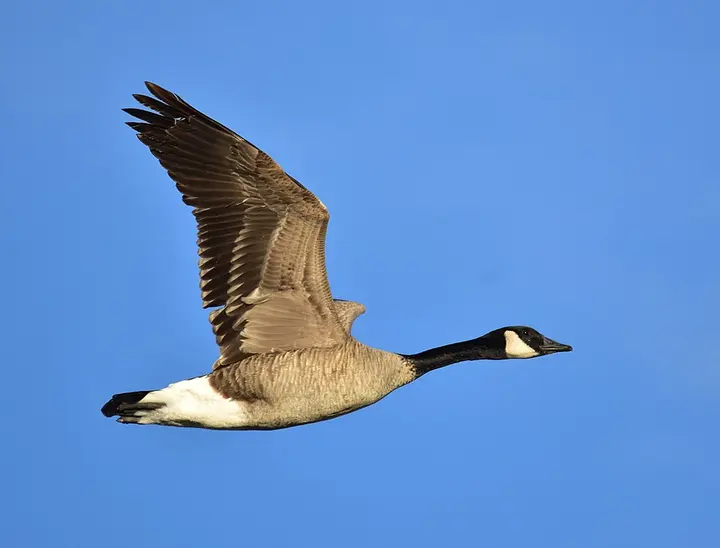
The Canada goose is a large species of goose with a black head and neck, white cheeks, white under its chin, and a brown body. It is native to the Arctic and temperate regions of North America, and it is occasionally found during migration across the Atlantic in northern Europe. It has been introduced to France, the United Kingdom, Ireland, Scandinavia, New Zealand, Japan, Chile, Argentina, and the Falkland Islands.
Like most geese, the Canada goose is primarily herbivorous and normally migratory; often found on or close to fresh water, the Canada goose is also common in brackish marshes, estuaries, and lagoons. Adept at living in human-altered areas, Canada geese have established breeding colonies in urban and cultivated habitats, which provide food and have few natural predators. The success of this common park species has led to it often being considered a pest species. This is because of its excrement, its depredation of crops, its noise, its aggressive territorial behavior toward both humans and other animals, and its habit of stalking and begging for food. The last is a result of humans not following artificial feeding policies toward wild animals.
Appearance
The seven subspecies of this bird vary widely in size and plumage details but all are recognizable as Canada geese. Some of the smaller subspecies can be hard to distinguish from the cackling goose, which slightly overlap in mass. However most subspecies of the cackling goose (exclusive of Richardson's cackling goose, B. h. hutchinsii) are considerably smaller. The smallest cackling goose, B. h. minima, is scarcely larger than a mallard.
Behaviour
Like most geese, the Canada goose is naturally migratory with the wintering range being most of the United States. The calls overhead from large groups of Canada geese flying in a V-shaped formation signal the transitions into spring and autumn. In some areas, migration routes have changed due to changes in habitat and food sources.
Diet
Canada geese are primarily herbivores, although they sometimes eat small insects and fish. Their diet includes green vegetation and grains. The Canada goose eats a variety of grasses when on land. It feeds by grasping a blade of grass with the bill, then tearing it with a jerk of the head. The Canada goose also eats beans and grains such as wheat, rice, and corn when they are available.
Habitat
This species is native to North America. It breeds in Canada and the northern United States in a wide range of habitats. The Great Lakes region maintains a large population of Canada geese. Canada geese live year-round in the southern part of their breeding range, including the northern half of the United States' eastern seaboard and Pacific Coast, and areas in between.
Where the Canada goose lives
Recorded in United States of America and Canada (North America and Europe).
Introduced, not native, in Sweden, United Kingdom, Belgium and Netherlands.
Most records fall in Ontario, New York, California, Pennsylvania, Ohio and Québec.
See the Canada goose’s range on the globe
Conservation status
Least concern (LC). Not at risk: it is doing well in the wild. Categories are the IUCN Red List as republished by GBIF.
Sources
The range is a density of 23,357,213 georeferenced GBIF records, shown on the continents where it is mainly recorded, not an expert-drawn map. Description from Wikipedia.