Animals / Mammal
California sea lion
Zalophus californianus · Otariidae
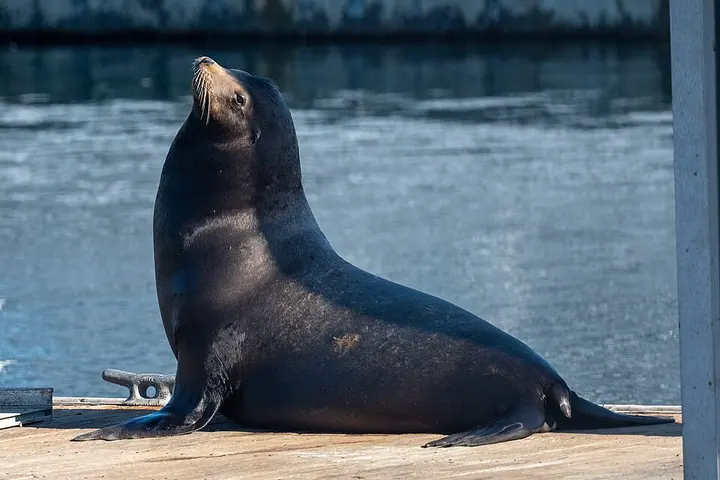
The California sea lion is a coastal eared seal native to western North America. It is one of six species of sea lions. Its natural habitat ranges from southeast Alaska to central Mexico, including the Gulf of California.
California sea lions are sexually dimorphic; males are larger than females, and have a thicker neck, and a protruding sagittal crest. They mainly haul out on sandy or rocky beaches, but they also frequent manmade environments such as marinas and wharves. California sea lions feed on a number of species of fish and squid, and are preyed on by orcas and great white sharks. California sea lions have a polygynous breeding pattern. From May to August, males establish territories and try to attract females with which to mate. Females are free to move in between territories, and are not coerced by males. Mothers nurse their pups in between foraging trips. California sea lions communicate with numerous vocalizations, notably with barks and mother-pup contact calls.
Behaviour
As an otariid, the California sea lion relies on its foreflippers to propel itself when swimming. This form of aquatic locomotion, along with its streamlined body, effectively reduces drag underwater. Its foreflipper movement is not continuous; the animal glides in between each stroke. The flexibility of its spine allows the California sea lion to bend its neck backwards far enough to reach its hindflippers.
Diet
California sea lions feed on a wide variety of seafood, mainly octopus, squid and fish, and sometimes clams. Commonly eaten fish and squid species include salmon, hake, Pacific whiting, anchovy, herring, rockfish, lamprey, dogfish, and market squid. They mostly forage near mainland coastlines, the continental shelf, and seamounts. They may also search along the ocean bottom.
Habitat
The California sea lion ranges along the western coast and islands of North America, from southeast Alaska to central Mexico. Mitochondrial DNA sequences in 2009 have identified five distinct California sea lion populations: the U.S. or Pacific Temperate stock, the Western Baja California or Pacific Tropical stock, and the Southern, Central, and Northern Gulf of California stocks.
Life cycle
California sea lions breed gregariously between May and August, when they arrive at their breeding rookeries. When establishing a territory, the males will try to increase their chances of reproducing by staying on the rookery for as long as possible. During this time, they will fast, relying on a thick layer of fat called blubber for energy.
Where the California sea lion lives
Recorded in United States of America, Mexico and Canada (North America).
Most records fall in California, Baja California Sur, British Columbia, Washington, Oregon and Baja California.
See the California sea lion’s range on the globe
Conservation status
Least concern (LC). Not at risk: it is doing well in the wild. Categories are the IUCN Red List as republished by GBIF.
Sources
The range is a density of 43,885 georeferenced GBIF records, shown on the continents where it is mainly recorded, not an expert-drawn map. Description from Wikipedia.