Animals / Bird
California quail
Callipepla californica · Odontophoridae
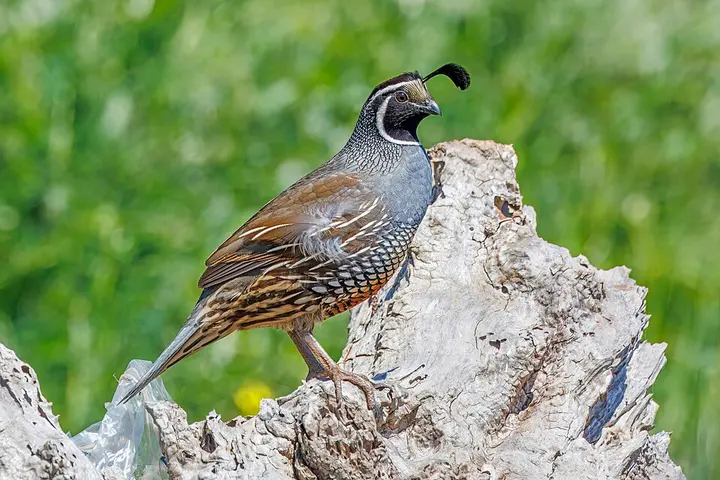
The California quail, also known as the California valley quail or Valley quail, is a small ground-dwelling bird in the New World quail family, inhabiting western North America. It is the state bird of California.
Appearance
These birds have a curving crest, plume or topknot, longer in males than females. Adult males are gray and brown colored, with a black face outlined by white stripes. Females are a plainer brown color and do not have the facial stripes. In terms of size, this bird typically measures 24–27 cm (9.4–10.6 in) in length, 32–37 cm (13–15 in) in wingspan, and weigh 140–230 g (4.9–8.1 oz).
Behaviour
The California quail is a highly sociable bird that often gathers in small flocks known as "coveys". One of their daily communal activities is a dust bath. A group of quail will select an area where the ground has been newly turned or is soft, and using their underbellies, will burrow downward into the soil some one to two inches. They then wriggle about in the indentations they have created, flapping their wings and ruffling their feathers, causing dust to rise in the air.
Life cycle
Their breeding habitat is shrubby areas and open woodlands in western North America. The nest is a shallow scrape lined with vegetation on the ground beneath a shrub or other cover. The female usually lays 12–16 eggs, measuring 3.2 cm (1.3 in) in length and 2.5 cm (0.98 in) in width. Once hatched, the young associate with both adults. Often, families group together, into multifamily "communal broods" which include at least two females, multiple males and many offspring.
Where the California quail lives
Recorded in United States of America (North America, South America and Oceania).
Introduced, not native, in Canada, Chile and New Zealand.
Most records fall in California, Washington, Oregon, British Columbia, Idaho and Utah.
See the California quail’s range on the globe
Conservation status
Least concern (LC). Not at risk: it is doing well in the wild. Categories are the IUCN Red List as republished by GBIF.
Sources
The range is a density of 1,486,235 georeferenced GBIF records, shown on the continents where it is mainly recorded, not an expert-drawn map. Description from Wikipedia.