Animals / Bird
California condor
Gymnogyps californianus · Cathartidae
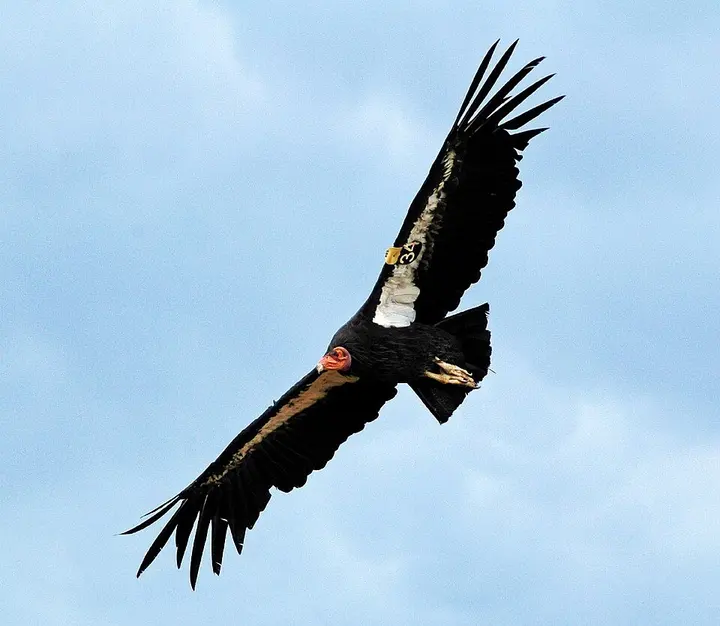
The California condor is a New World vulture and the largest North American land bird. It became extinct in the wild in 1987 when all remaining wild individuals were captured, but has since been reintroduced to northern Arizona and southern Utah, the coastal mountains of California, and northern Baja California in Mexico. It is the only surviving member of the genus Gymnogyps, although four extinct members of the genus are also known.
The species is listed by IUCN as critically endangered, and similarly considered Critically Imperiled by NatureServe. The plumage is black with patches of white on the underside of the wings; the head is largely bald, with skin color ranging from gray on young birds to yellow and bright orange on breeding adults. Its 3.0 m (9.8 ft) wingspan is the widest of any North American bird, and its weight of up to 14 kg (31 lb) nearly equals that of the trumpeter swan, the heaviest among native North American bird species. The condor is a scavenger and eats large amounts of carrion. It is one of the world's longest-living birds, with a lifespan of up to 60 years.
Appearance
The adult California condor is a uniform black with the exception of large triangular patches or bands of white on the underside of the wings. It has gray legs and feet, an ivory-colored bill, a frill of black feathers surrounding the base of the neck, and brownish red eyes. The juvenile is mostly a mottled dark brown with blackish coloration on the head. It has mottled gray instead of white on the underside of its flight feathers.
Behaviour
The California condor's large flight muscles are not anchored by a correspondingly large sternum, which restricts them to being primarily soarers. The birds flap their wings when taking off from the ground, but after attaining a moderate elevation they largely glide, sometimes going for miles without a single flap of their wings. They have been known to fly up to speeds of 90 km/h (56 mph) and as high as 4,600 m (15,100 ft).
Diet
Wild condors maintain a large home range, often traveling 250 km (160 mi) a day in search of carrion. It is thought that in the early days of its existence as a species, the California condor lived off the carcasses of the Pleistocene megafauna, which are largely extinct in North America. They still prefer to feast on large, terrestrial mammalian carcasses such as deer, goats, sheep, donkeys, horses, pigs, cougars, bears, or cattle.
Habitat
The California condor lives in rocky shrubland, coniferous forest, and oak savanna. They are often found near cliffs or large trees, which they use as nesting sites. Individual birds have a huge range and have been known to travel up to 250 km (160 mi) in search of carrion. There are two sanctuaries chosen because of their prime condor nesting habitat: the Sisquoc Condor Sanctuary in the San Rafael Wilderness and the Sespe Condor Sanctuary in the Los Padres National Forest.
Where the California condor lives
Recorded in United States of America (North America).
Most records fall in California, Arizona, Utah and New Mexico.
See the California condor’s range on the globe
Conservation status
Critically endangered (CR). In very great danger of dying out in the wild. Categories are the IUCN Red List as republished by GBIF.
Sources
The range is a density of 33,680 georeferenced GBIF records, shown on the continents where it is mainly recorded, not an expert-drawn map. Description from Wikipedia.