Animals / Insect
Buff-tailed bumblebee
Bombus terrestris · Apidae
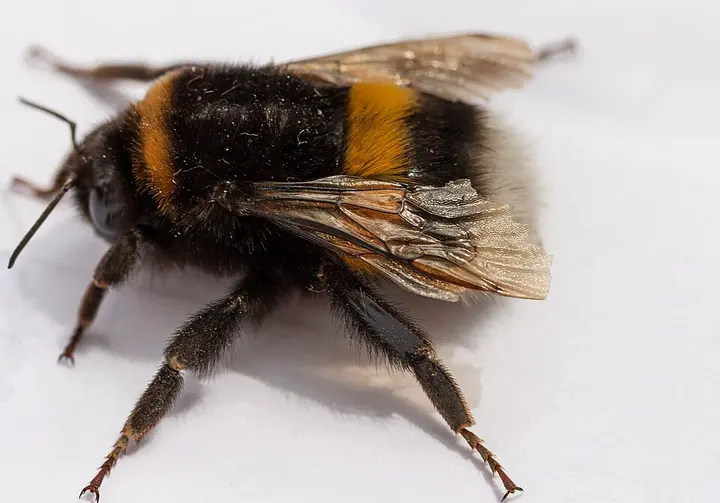
Bombus terrestris, the buff-tailed bumblebee or large earth bumblebee, is one of the most numerous bumblebee species in Europe. It is one of the main species used in greenhouse pollination, and so can be found in many countries and areas where it is not native, such as Tasmania. Moreover, it is a eusocial insect with an overlap of generations, a division of labour, and cooperative brood care.
The queen is monogamous, which means she mates with only one male. B. terrestris workers learn flower colours and forage efficiently.
Habitat
B. terrestris is most commonly found throughout Europe and generally occupies temperate climates. Because it can survive in a wide variety of habitats, there are populations in the Near East, the Mediterranean Islands, and Northern Africa as well.
Life cycle
A solitary queen hatched from her abandoned colony initiates the colony cycle when she mates with a male and finds a nest. She will stay in this nest over winter and then will lay a small batch of diploid (female) eggs in the spring. Once these hatch, she tends the larvae, feeding them with nectar and pollen. When the larvae are grown, they pupate, and about two weeks later, the first workers emerge. This is known as the initiation phase of the colony.
Where the Buff-tailed bumblebee lives
Recorded in Netherlands, Germany, United Kingdom, Sweden, Switzerland, France, Belgium and Ireland (Europe).
Most records fall in Zuid-Holland, Nordrhein-Westfalen, Gelderland, Bayern, Noord-Holland and Niedersachsen.
See the Buff-tailed bumblebee’s range on the globe
Conservation status
Not evaluated (NE). Scientists haven’t checked yet how at risk it is, so this doesn’t mean it is safe or in danger. Categories are the IUCN Red List as republished by GBIF.
Sources
The range is a density of 612,413 georeferenced GBIF records, shown on the continents where it is mainly recorded, not an expert-drawn map. Description from Wikipedia.