Animals / Bird
Brown pelican
Pelecanus occidentalis · Pelecanidae
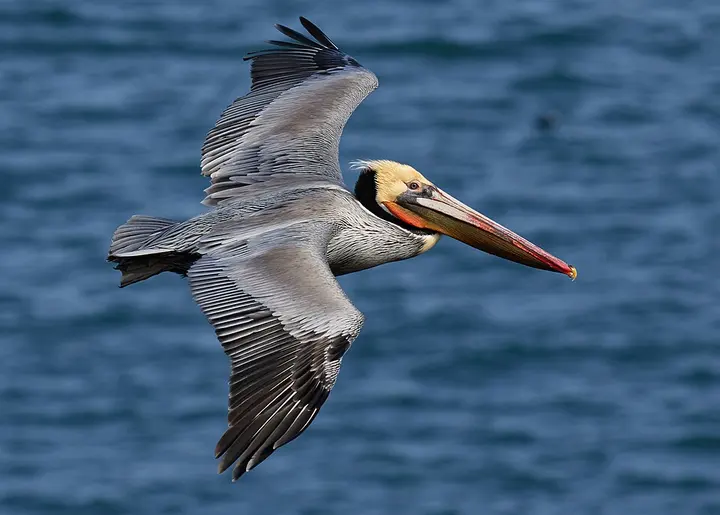
The brown pelican is a bird of the pelican family, Pelecanidae, one of three species found in the Americas and one of two that feed by diving into water. It is found on the Atlantic Coast from New Jersey to the mouth of the Amazon River, and along the Pacific Coast from British Columbia to Peru, including the Galapagos Islands. The nominate subspecies in its breeding plumage has a white head with a yellowish wash on the crown.
The nape and neck are dark maroon–brown. The upper sides of the neck have white lines along the base of the gular pouch, and the lower fore neck has a pale yellowish patch. The male and female are similar, but the female is slightly smaller. The nonbreeding adult has a white head and neck. The pink skin around the eyes becomes dull and gray in the nonbreeding season. It lacks any red hue, and the pouch is strongly olivaceous ochre-tinged and the legs are olivaceous gray to blackish-gray. The brown pelican mainly feeds on fish, but occasionally eats amphibians, crustaceans, and the eggs and nestlings of birds. It nests in colonies in secluded areas, often on islands, vegetated land among sand dunes, thickets of shrubs and trees, and mangroves.
Appearance
The brown pelican is the smallest of the eight extant pelican species, but is often one of the larger seabirds in their range nonetheless. It measures 1 to 1.52 m (3 ft 3 in to 5 ft 0 in) in length and has a wingspan of 2.03 to 2.28 m (6 ft 8 in to 7 ft 6 in). The weight of adults can range from 2 to 5 kg (4.4 to 11.0 lb), about half the weight of the other pelicans found in the Americas, the Peruvian and American white pelicans.
Behaviour
The brown pelican is a very gregarious bird; it lives in flocks of both sexes throughout the year. In level flight, brown pelicans fly in groups, with their heads held back on their shoulders and their bills resting on their folded necks. They may fly in a V formation, but usually in regular lines or single file, often low over the water's surface. To exclude water from the nasal passage, they have narrower internal regions of the nostrils.
Diet
The brown pelican is a piscivore, primarily feeding on fish. Menhaden may account for 90% of its diet, and the anchovy supply is particularly important to the brown pelican's nesting success. Other fish preyed on with some regularity includes pigfish, pinfish, herring, sheepshead, silversides, mullets, sardines, minnows, and topminnows.
Habitat
The brown pelican lives on the Atlantic, Gulf, and Pacific Coasts in the Americas. On the Atlantic Coast, it is found from the New Jersey coast to the mouth of the Amazon River. Along the Pacific Coast, it is found from British Columbia to northern Peru, including the Galapagos Islands. After nesting, North American birds move in flocks further north along the coasts, returning to warmer waters for winter. In the non-breeding season, it is found as far north as Canada.
Where the Brown pelican lives
Recorded in United States of America, Mexico, Costa Rica and Ecuador (North America and South America).
Most records fall in California, Florida, Texas, South Carolina, North Carolina and Virginia.
See the Brown pelican’s range on the globe
Conservation status
Least concern (LC). Not at risk: it is doing well in the wild. Categories are the IUCN Red List as republished by GBIF.
Sources
The range is a density of 2,919,295 georeferenced GBIF records, shown on the continents where it is mainly recorded, not an expert-drawn map. Description from Wikipedia.