Animals / Mammal
Brown bear
Ursus arctos · Ursidae
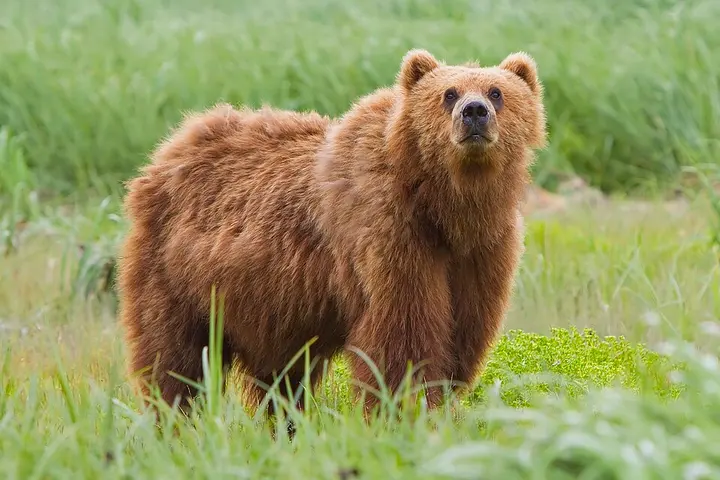
The brown bear is a large bear native to Eurasia and North America. Of the land carnivorans, it is rivaled in size only by its closest relative, the polar bear, which is much less variable in size and slightly bigger on average. The brown bear is a sexually dimorphic species, as adult males are larger and more compactly built than females.
The fur ranges in color from cream to reddish to dark brown. It has evolved large hump muscles, unique among bears, and paws up to 21 cm (8.3 in) wide and 36 cm (14 in) long, to effectively dig through dirt. Its teeth are similar to those of other bears and reflect its dietary plasticity. Throughout the brown bear's range, it inhabits mainly forested habitats in elevations of up to 5,000 m (16,000 ft). It is omnivorous, and consumes a variety of plant and animal species. Contrary to popular belief, the brown bear derives 90% of its diet from plants. When hunting, it will target animals as small as insects and rodents to those as large as moose or muskoxen. In parts of coastal Alaska, brown bears predominantly feed on spawning salmon that come near shore to lay their eggs.
Appearance
The brown bear is the most variable in size of modern bears. The typical size depends upon which population it is from, as most accepted subtypes vary widely in size. This is in part due to sexual dimorphism, as male brown bears average at least 30% larger than females in most subtypes.
Behaviour
Several different facial expressions have been documented in brown bears. The "relaxed-face" is made during everyday activities, a face where the ears pointed to the sides and the mouth closed or slackly open. During social play, bears make "relaxed open-mouth face" in which the mouth is open, with a curled upper lip and hanging lower lip, and the ears alert and shifting.
Habitat
Brown bears inhabit the broadest range of habitats of any living bear species. They seem to have no altitudinal preferences and have been recorded from sea level to an elevation of 5,000 m (16,000 ft) in the Himalayas. In most of their range, brown bears seem to prefer semi-open country, with a scattering of vegetation, that can allow them a resting spot during the day. However, they have been recorded as inhabiting every variety of northern temperate forest known to occur.
Life cycle
The mating season occurs from mid-May to early July, shifting to later in the year the farther north the bears are found. Brown bears are polygynandrous, remaining with the same mate for a couple of days to a couple of weeks and mating multiply during the mating season. Outside of this narrow time frame, adult male and female brown bears show no sexual interest in each other. Females mature sexually between the ages of four and eight.
Where the Brown bear lives
Recorded in Norway, United States of America, Sweden, France, Russia, Canada, Switzerland, Estonia, Romania, Spain and Finland (Europe, North America and Asia).
Most records fall in Nord-Trøndelag, Alaska, Hedmark, Jämtland, Wyoming and Sør-Trøndelag.
See the Brown bear’s range on the globe
Conservation status
Least concern (LC). Not at risk: it is doing well in the wild. Categories are the IUCN Red List as republished by GBIF.
Sources
The range is a density of 48,258 georeferenced GBIF records, shown on the continents where it is mainly recorded, not an expert-drawn map. Description from Wikipedia.