Animals / Mammal
Bornean orangutan
Pongo pygmaeus · Hominidae
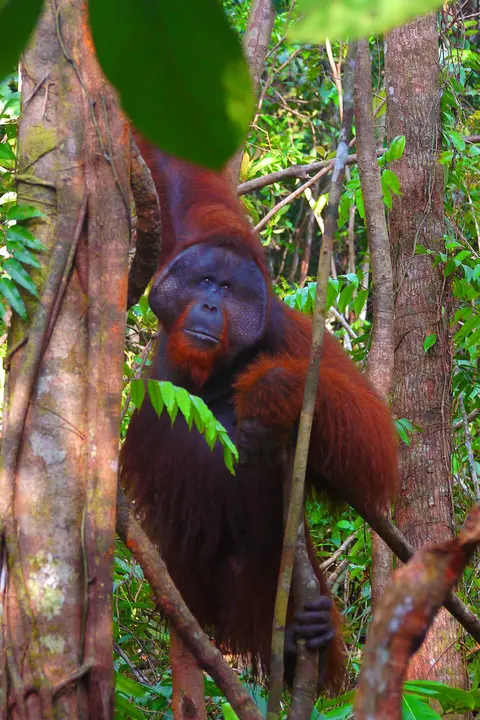
The Bornean orangutan is an orangutan species endemic to the island of Borneo. It belongs to the only genus of great apes native to Asia and is the largest of the three Pongo species. It has a coarse, reddish coat and up to 1.5 m long arms.
It is sexually dimorphic — males are larger than females and develop large cheek pads (flanges). The Bornean orangutan inhabits Borneo lowland rain forests and Borneo montane rain forests up to an elevation of 1,500 m (4,900 ft). Its diet includes fruits, seeds, flowers, bird eggs, sap and vines. It is highly intelligent, displaying tool use and distinct cultural patterns. It is listed as Critically Endangered, with deforestation, palm oil plantations, and hunting posing a serious threat to its survival. It is scheduled as a "totally protected animal" under Sarawak state law through the 1998 Wild Life Protection Ordinance.
Appearance
The Bornean orangutan is the third-largest ape after the western gorilla, and the largest truly arboreal (or tree-dwelling) extant ape. Body weights broadly overlap with the considerably taller Homo sapiens, but the latter is considerably more variable in size. By comparison, the Sumatran orangutan is similar in size but, on average, is marginally lighter in weight.
Behaviour
In history, orangutans ranged throughout Southeast Asia and into southern China, as well as on the island of Java and in southern Sumatra. They primarily inhabit peat swamp forest, tropical heath forest, and mixed dipterocarp forest. Bornean orangutan are more solitary than their Sumatran relatives. Two or three orangutans with overlapping territories may interact, but only for short periods of time.
Diet
The Bornean orangutan's diet is composed of over 400 types of food, including wild figs, Durio zibethinus and D. graveolens, leaves, seeds, flowers, sap, the inner shoots of plants and vines, bark, honey, fungi, bird eggs, spider webs and insects. It get the necessary quantities of water from both fruit and from tree holes. Some individuals have been observed eating dead fish on shores and even grabbing live fish out of the water.
Habitat
The Bornean orangutan occurs in the two Malaysian states of Sabah and Sarawak, and four of the five Indonesian Provinces of Kalimantan, while its presence in Brunei is uncertain and unconfirmed; due to habitat destruction, its distribution is patchy throughout the island, and it has become rare in the southeast of Borneo and in the forest between the Rajang River in central Sarawak and the Padas River in western Sabah It lives in the Borneo lowland rain forests and in the Borneo montane rain forests in mountainous areas up to 1,500 m (4,900 ft).
Where the Bornean orangutan lives
Recorded in Malaysia and Indonesia (Asia).
Most records fall in Sabah, Kalimantan Tengah, Sarawak, Kalimantan Barat, Kalimantan Timur and Kalimantan Selatan.
See the Bornean orangutan’s range on the globe
Conservation status
Critically endangered (CR). In very great danger of dying out in the wild. Categories are the IUCN Red List as republished by GBIF.
Sources
The range is a density of 2,607 georeferenced GBIF records, shown on the continents where it is mainly recorded, not an expert-drawn map. Description from Wikipedia.