Animals / Mammal
Bonobo
Pan paniscus · Hominidae
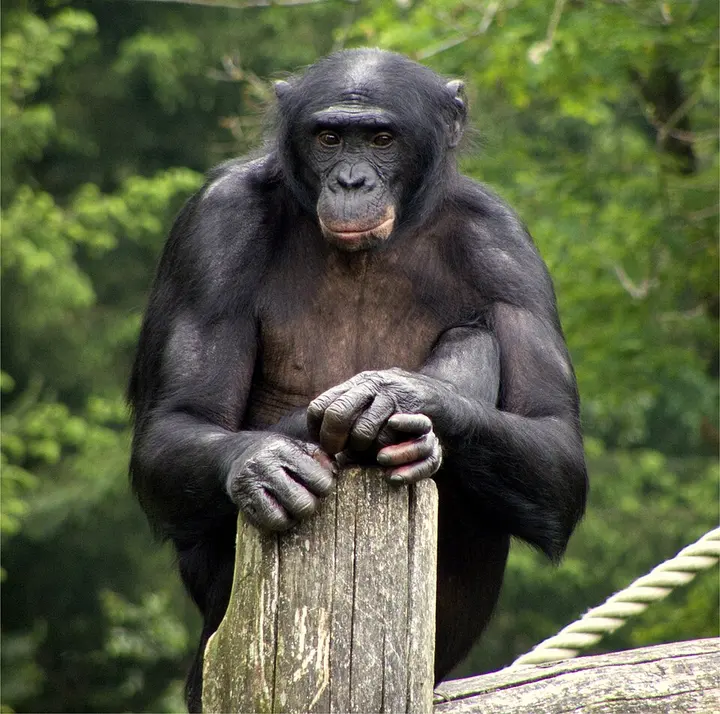
The bonobo, also historically called the pygmy chimpanzee, is the smallest species of great ape and one of the two making up the genus Pan. While bonobos are today recognized as a distinct species, they were initially thought to be a subspecies of Pan troglodytes, because of the physical similarities between the two species. Taxonomically, members of the chimpanzee/bonobo subtribe Panina—composed entirely by the genus Pan—are collectively termed panins.
Bonobos are distinguished from common chimpanzees by relatively long limbs, pinker lips, a darker face, a tail-tuft through adulthood, and longer, parted hair on their heads. Some individuals have sparser, thin hair over parts of their bodies. Bonobos typically live 40 years in captivity; their lifespan in the wild is unknown, but it is almost certainly much shorter. The bonobo is found in a 500,000 km2 (190,000 sq mi) area within the Congo Basin of the Democratic Republic of the Congo (DRC), Central Africa. It is predominantly frugivorous, compared to the often highly omnivorous diets and hunting of small monkeys, duiker and other antelope exhibited by common chimpanzees. Bonobos inhabit primary and secondary forest, including seasonally inundated swamp forest.
Appearance
The bonobo is commonly considered to be more gracile than the common chimpanzee. Although large male chimpanzees can exceed any bonobo in bulk and weight, the two species broadly overlap in body size. Adult female bonobos are somewhat smaller than adult males. Body mass ranges from 34 to 60 kg (75 to 132 lb) with an average weight of 45 kilograms (99 lb) in males against an average of 33 kg (73 lb) in females.
Behaviour
Primatologist Frans de Waal states bonobos are capable of altruism, compassion, empathy, kindness, patience, and sensitivity, and described "bonobo society" as a "gynecocracy" (i.e. a matriarchy). Primatologists who have studied bonobos in the wild have documented a wide range of behaviours, including aggressive behaviour and more cyclic sexual behaviour similar to chimpanzees, even though bonobos show more sexual behaviour in a greater variety of relationships.
Diet
The bonobo is an omnivorous frugivore; 57% of its diet is fruit, but this is supplemented with leaves, honey, eggs, meat from small vertebrates such as anomalures, flying squirrels and duikers, and invertebrates. The truffle species Hysterangium bonobo is eaten by bonobos. In some instances, bonobos have been shown to consume lower-order primates. Some claim bonobos have also been known to practise cannibalism in captivity, a claim disputed by others.
Habitat
Bonobos are found only south of the Congo River and north of the Kasai River (a tributary of the Congo), in the humid forests of the Democratic Republic of Congo. Ernst Schwarz's 1927 paper "Le Chimpanzé de la Rive Gauche du Congo", announcing his discovery, has been read as an association between the Parisian Left Bank and the left bank of the Congo River; the bohemian culture in Paris, and an unconventional ape in the Congo.
Where the Bonobo lives
Recorded in Dem. Rep. Congo (Africa).
Most records fall in Orientale, Bandundu, Équateur and Kasaï-Oriental.
See the Bonobo’s range on the globe
Conservation status
Endangered (EN). In danger of dying out in the wild. Categories are the IUCN Red List as republished by GBIF.
Sources
The range is a density of 61 georeferenced GBIF records, shown on the continents where it is mainly recorded, not an expert-drawn map. Description from Wikipedia.