Animals / Mammal
Bongo
Tragelaphus eurycerus · Bovidae
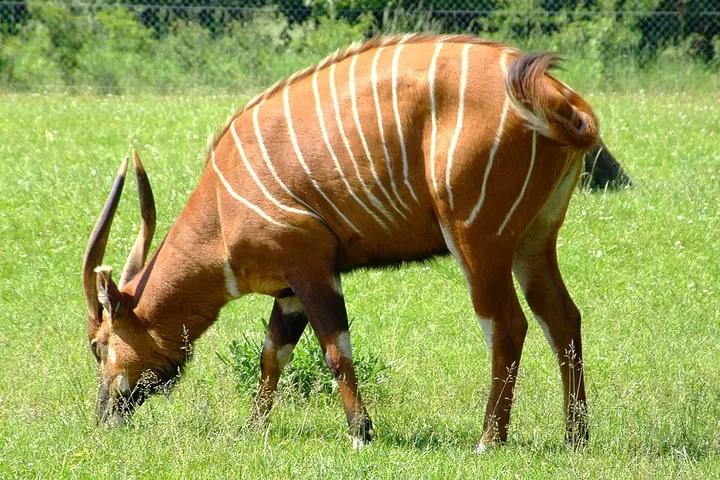
The bongo is a large, mostly nocturnal, forest-dwelling antelope, native to sub-Saharan Africa. Bongos are characterised by a striking reddish-brown coat, black-and-white markings, white-yellow stripes, and long, slightly spiraled horns. Bongos have complex social interactions and are found in African dense forest mosaics.
They are the third-largest antelope in the world. In 2000, the Association of Zoos and Aquariums in the US upgraded the bongo to a Species Survival Plan participant and in 2006 added the Bongo Restoration to Mount Kenya Project to its list of the Top Ten Wildlife Conservation Success Stories of the year. As of 2013, these successes have been compromised by reports of possibly only 100 mountain bongos left in the wild due to logging and poaching.
Appearance
Bongos are one of the largest of the forest antelopes. In addition to the deep chestnut colour of their coats, they have bright white stripes on their sides to help with camouflage. Adults of both sexes are similar in size. Adult height is about 1.1 to 1.3 m (3.6 to 4.3 ft) at the shoulder and length is 2.15 to 3.15 m (7.1 to 10.3 ft), including a tail of 45–65 cm (18–26 in). Females weigh around 150–235 kg (331–518 lb), while males weigh about 220–405 kg (485–893 lb).
Behaviour
Bongos are found in tropical jungles with dense undergrowth up to an altitude of 4,000 m (13,000 ft) in Central Africa, with isolated populations in Kenya, and these West African countries: Cameroon, the Central African Republic, the Republic of the Congo, the Democratic Republic of the Congo, Ivory Coast, Equatorial Guinea, Gabon, Ghana, Guinea, Liberia, Sierra Leone, and South Sudan. Historically, bongos are found in three disjunct parts of Africa: East, Central, and West.
Diet
Like many forest ungulates, bongos are herbivorous browsers and feed on leaves, bushes, vines, bark and pith of rotting trees, grasses/herbs, roots, cereals, and fruits. Bongos require salt in their diets and are known to visit natural salt licks regularly. They also are known to eat burnt wood after a storm, a rich source of salt and minerals. This behavior is believed to be a means of getting salts and minerals into their diets.
Habitat
Bongos are found in tropical jungles with dense undergrowth up to an altitude of 4,000 m (13,000 ft) in Central Africa, with isolated populations in Kenya, and these West African countries: Cameroon, the Central African Republic, the Republic of the Congo, the Democratic Republic of the Congo, Ivory Coast, Equatorial Guinea, Gabon, Ghana, Guinea, Liberia, Sierra Leone, and South Sudan. Historically, bongos are found in three disjunct parts of Africa: East, Central, and West.
Where the Bongo lives
Recorded in Central African Rep., Liberia, Congo, Côte d'Ivoire, Kenya and Dem. Rep. Congo (Africa).
Most records fall in Mbomou, Sinoe, Haute-Kotto, Sangha-Mbaéré, Central and Cuvette-Ouest.
See the Bongo’s range on the globe
Conservation status
Near threatened (NT). Not at risk yet, but could be soon. Categories are the IUCN Red List as republished by GBIF.
Sources
The range is a density of 261 georeferenced GBIF records, shown on the continents where it is mainly recorded, not an expert-drawn map. Description from Wikipedia.