Animals / Mammal
Blue whale
Balaenoptera musculus · Balaenopteridae
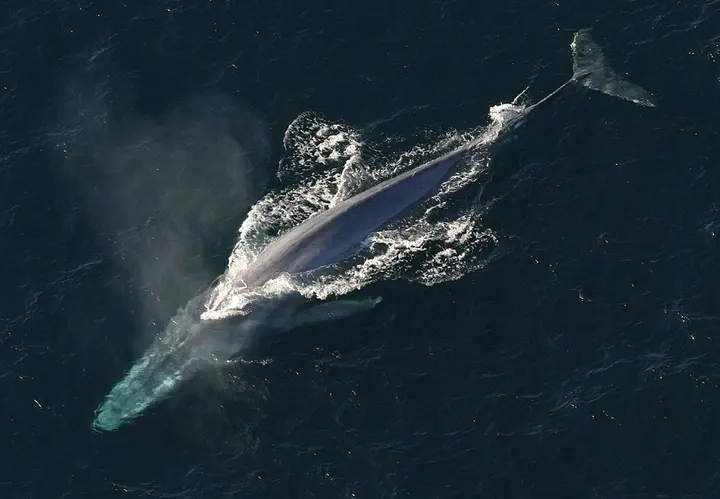
The blue whale is a species of baleen whale and the largest marine mammal in the rorqual family Balaenopteridae. Reaching a maximum confirmed length of 29.9–30.5 m (98–100 ft) and weighing up to 190–200 t, it is the largest animal known to have ever existed. The blue whale's long and slender body can be of various shades of greyish-blue on its upper surface and somewhat lighter underneath.
Four subspecies are recognized: B. m. musculus in the North Atlantic and North Pacific, B. m. intermedia in the Southern Ocean, B. m. brevicauda (the pygmy blue whale) in the Indian Ocean and South Pacific Ocean, and B. m. indica in the Northern Indian Ocean. There is a population in the waters off Chile that may constitute a fifth subspecies. In general, blue whale populations migrate between their summer feeding areas near the poles and their winter breeding grounds near the tropics. There is also evidence of year-round residencies, and partial or age- and sex-based migration. Blue whales are filter feeders; their diet consists almost exclusively of krill. They are generally solitary or gather in small groups, and have no well-defined social structure other than mother–calf bonds.
Appearance
The blue whale is a slender-bodied cetacean with a broad U-shaped head; thin, elongated flippers; a small sickle-shaped dorsal fin located close to the tail, and a large tail stock at the root of the wide and thin flukes. The upper jaw is lined with 70–400 black baleen plates less than 1 m (3.3 ft) in length. The throat region has 60–88 grooves which allows the skin to expand during feeding. It has two blowholes that can squirt 9.1–12 m (30–39 ft) up in the air.
Behaviour
The blue whale is usually solitary, but can be found in pairs. When productivity is high enough, blue whales can be seen in gatherings of more than 50 individuals. Populations may go on long migrations, traveling to their summer feeding grounds towards the poles and then heading to their winter breeding grounds in more equatorial waters. The animals appear to use memory to locate the best feeding areas.
Diet
The blue whale's diet consists almost exclusively of krill, which they capture through lunge feeding, where they swim towards krill at high speeds with their mouths open up to 80 degrees. They may engulf 220 t (220 long tons; 240 short tons) of water at one time. They squeeze the water out through their baleen plates with pressure from the throat pouch and tongue, and swallow the remaining krill.
Where the Blue whale lives
Recorded in United States of America, Antarctica, Portugal, Mexico, S. Geo. and the Is., Ashmore and Cartier Is., Canada and Chile (North America, Antarctica, Europe, Seven seas (open ocean), Oceania and South America).
Most records fall in California, Azores, Baja California Sur, Victoria, Québec and South Australia.
See the Blue whale’s range on the globe
Conservation status
Endangered (EN). In danger of dying out in the wild. Categories are the IUCN Red List as republished by GBIF.
Sources
The range is a density of 28,439 georeferenced GBIF records, shown on the continents where it is mainly recorded, not an expert-drawn map. Description from Wikipedia.