Animals / Bird
Blue jay
Cyanocitta cristata · Corvidae
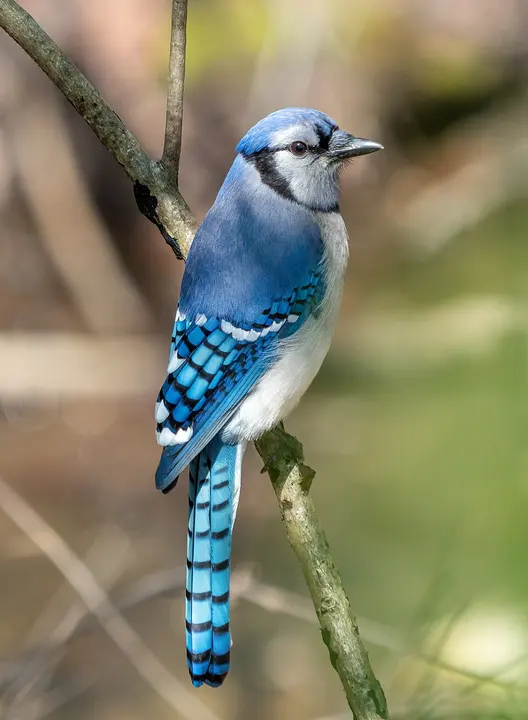
The blue jay is a passerine bird in the family Corvidae, native to eastern North America. It lives in most of the eastern and central United States; some eastern populations may be migratory. Resident populations are also in Newfoundland, Canada; breeding populations are found across southern Canada.
It breeds in both deciduous and coniferous forests, and is common in residential areas. Its coloration is predominantly blue, with a white chest and underparts, and a blue crest; it has a black, U-shaped collar around its neck and a black border behind the crest. Males and females are similar in size and plumage, which does not vary throughout the year. Four subspecies have been recognized. The blue jay feeds mainly on seeds and nuts, such as acorns, which it may hide to eat later; soft fruits; arthropods; and occasionally small vertebrates. It typically gleans food from trees, shrubs, and the ground, and sometimes hawks insects from the air. Blue jays can be very aggressive to other birds; they sometimes raid nests and have even been found to have decapitated other birds.
Appearance
The blue jay measures 22–30 cm (9–12 in) from bill to tail and weighs 70–100 g (2.5–3.5 oz), with a wingspan of 34–43 cm (13–17 in). Consistent with Bergmann's rule, jays from Connecticut averaged 92.4 g (3.26 oz) in weight, while jays from warmer southern Florida averaged 73.7 g (2.60 oz). There is a pronounced crest on the head, a crown of feathers, which may be raised or lowered according to the bird's mood. When excited or aggressive, the crest will be fully raised.
Behaviour
The blue jay is a noisy, bold, and aggressive passerine. It is a moderately slow flier (roughly 32–40 km/h or 20–25 mph) when unprovoked. It flies with body and tail held level, with slow wing beats. Its slow flying speeds make this species easy prey for hawks and owls when it flies in open areas. Virtually all the raptorial birds sympatric in distribution with the blue jay may prey upon it, especially swift bird-hunting specialists such as the Accipiter hawks.
Diet
Blue jays are omnivorous, but the Audubon Society estimates that 75% of their diet is vegetable matter. They have strong black bills which they use for cracking nuts, usually while holding them with their feet, and for eating corn, grains and seeds. Blue jays particularly love to eat peanuts in the shell.
Habitat
The blue jay occurs from southern Canada and throughout the eastern and central United States south to Florida and northeastern Texas. The western edge of the range stops where the arid pine forest and scrub habitat of the closely related Steller's jay (C. stelleri) begins, generally in the eastern foothills of the Rocky Mountains.
Where the Blue jay lives
Recorded in United States of America and Canada (North America).
Most records fall in New York, Ontario, Pennsylvania, Florida, Massachusetts and Michigan.
See the Blue jay’s range on the globe
Conservation status
Least concern (LC). Not at risk: it is doing well in the wild. Categories are the IUCN Red List as republished by GBIF.
Sources
The range is a density of 24,108,734 georeferenced GBIF records, shown on the continents where it is mainly recorded, not an expert-drawn map. Description from Wikipedia.