Animals / Mammal
Blue duiker
Cephalophus monticola · Bovidae
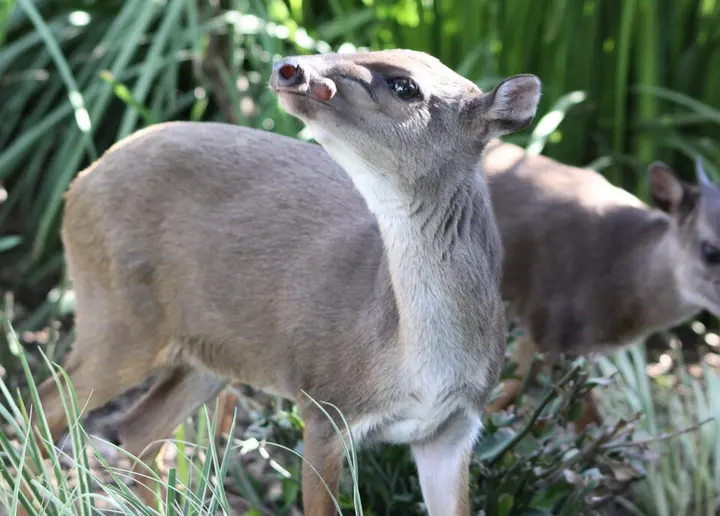
The blue duiker is a small antelope found in central, southern and eastern Africa. It is the smallest species of duiker. The species was first described by Swedish naturalist Carl Peter Thunberg in 1789. 12 subspecies are identified.
The blue duiker reaches 32–41 centimetres (13–16 in) at the shoulder and weighs 3.5–9 kilograms (7.7–19.8 lb). Sexually dimorphic, the females are slightly larger than the males. The dark tail measures slightly above 10 centimetres (3.9 in). It has short, spiky horns, around 5 centimetres (2.0 in) long and hidden in hair tufts. The subspecies show a great degree of variation in their colouration. The blue duiker bears a significant resemblance to Maxwell's duiker. Activity is diurnal (limited to daytime). Secretive and cautious, the blue duiker confines itself to the forest fringes. Territorial, individuals of opposite sexes form pairs and occupy territories, nearly 0.4–0.8 hectares (0.0015–0.0031 sq mi) large and marked by preorbital gland secretions.
Appearance
The blue duiker is a small antelope; in fact, it is the smallest duiker. The head-and-body length is typically between 55 and 90 centimetres (22 and 35 in). It reaches 32–41 centimetres (13–16 in) at the shoulder and weighs nearly 3.5–9 kilograms (7.7–19.8 lb). P. m. anchietae is the largest subspecies. Sexually dimorphic, the females are slightly larger than the males.
Behaviour
The blue duiker is diurnal (active during the day). Secretive and cautious, it confines itself to the forest fringes. Territorial, individuals of opposite sexes form pairs and occupy territories, nearly 0.4–0.8 hectares (0.0015–0.0031 sq mi) large and marked by preorbital gland secretions. The animal rubs the preorbital glands on trees and logs to mark its territory with the fluid produced by the glands. A vocal bovid, bird-like chirps denote curiosity in the animal.
Diet
The diet consists of fallen fruits, foliage, flowers and pieces of bark, provided mainly by the forest canopies in their habitat. Fungi, resin, particularly exudates from Albizia species and animal matter such as ants (which are licked from the ground) may also be included in the diet. The blue duiker can sustain itself on dead foliage better than other duiker species.
Habitat
This species can survive in a variety of forests, including old-growth, secondary and gallery forests. Forests are preferred as these provide the animal with shelter through the dense understory and forage through canopy. They can also be found in pockets of degraded and regenerated forests from the sea level up to an altitude of 3,000 metres (9,800 ft).
Where the Blue duiker lives
Recorded in Angola, South Africa, Central African Rep., Dem. Rep. Congo, Eq. Guinea and Uganda (Africa).
Most records fall in Bengo, KwaZulu-Natal, Mbomou, Orientale, Eastern Cape and Centro Sur.
See the Blue duiker’s range on the globe
Conservation status
Least concern (LC). Not at risk: it is doing well in the wild. Categories are the IUCN Red List as republished by GBIF.
Sources
The range is a density of 4,142 georeferenced GBIF records, shown on the continents where it is mainly recorded, not an expert-drawn map. Description from Wikipedia.