Animals / Mammal
Black rhinoceros
Diceros bicornis · Rhinocerotidae
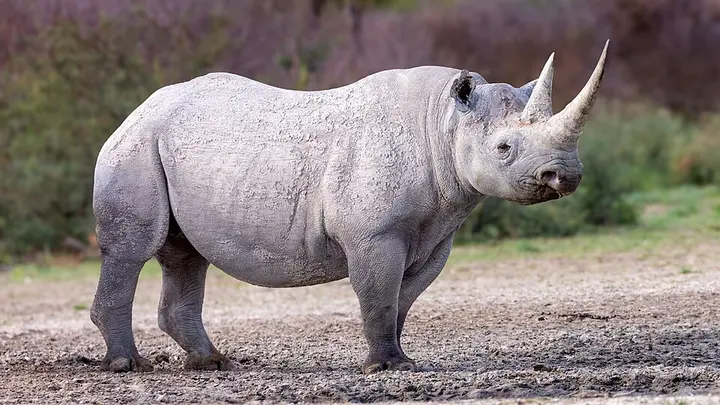
The black rhinoceros, also called the black rhino or the hooked-lip rhinoceros, is a species of rhinoceros native to East and Southern Africa, including Angola, Botswana, Eswatini, Kenya, Lesotho, Malawi, Mozambique, Namibia, South Africa, Tanzania, Zambia, and Zimbabwe. Although the species is referred to as black, its colours vary from brown to grey. It is the only extant species of the genus Diceros.
The other rhinoceros native to Africa is the white rhinoceros (Ceratotherium simum). The word "white" in the name "white rhinoceros" is often said to be a misinterpretation of the Afrikaans word wyd (Dutch wijd) meaning wide, referring to its square upper lip, as opposed to the pointed or hooked lip of the black rhinoceros. These species are now sometimes referred to as the square-lipped (for white) or hook-lipped (for black) rhinoceros. The species overall is classified as critically endangered (even though the south-western black rhinoceros is classified as near threatened) and is threatened by multiple factors including poaching and habitat reduction.
Appearance
An adult black rhinoceros stands 1.32–1.8 m (4.3–5.9 ft) high at the shoulder and is 2.8–3.75 m (9.2–12.3 ft) in length. An adult typically weighs from 800 to 1,400 kg (1,800 to 3,100 lb), however unusually large male specimens have been reported at up to 2.9 t (3.2 short tons). The cows are smaller than the bulls. Two horns on the skull are made of keratin with the larger front horn typically 50 cm (1.6 ft) long, exceptionally up to 135.9 cm (4.5 ft).
Behaviour
Black rhinos are generally thought to be solitary, with the only strong bond between a mother and her calf. In addition, bulls and cows have a consort relationship during mating, also subadults and young adults frequently form loose associations with older individuals of either sex. They are not very territorial and often intersect other rhino territories. Home ranges vary depending on season and the availability of food and water.
Diet
Black rhinos are herbivorous browsers that eat leafy plants, twigs, branches, shoots, thorny wood bushes, small trees, legumes, fruit, and grass. The optimum habitat seems to be one consisting of thick scrub and bushland, often with some woodland, which supports the highest densities.
Habitat
As with many other components of the African large mammal fauna, black rhinos probably had a wider range in the northern part of the continent in prehistoric times than today. However this seems to have not been as extensive as that of the white rhino. Unquestionable fossil remains have not yet been found in this area and the abundant petroglyphs found across the Sahara desert are often too schematic to unambiguously decide whether they depict black or white rhinos.
Where the Black rhinoceros lives
Recorded in Namibia, Kenya, Tanzania, South Africa and Zimbabwe (Africa).
Most records fall in Oshikoto, Arusha, Rift Valley, Oshana, KwaZulu-Natal and Eastern.
See the Black rhinoceros’s range on the globe
Conservation status
Critically endangered (CR). In very great danger of dying out in the wild. Categories are the IUCN Red List as republished by GBIF.
Sources
The range is a density of 2,435 georeferenced GBIF records, shown on the continents where it is mainly recorded, not an expert-drawn map. Description from Wikipedia.