Animals / Bird
Black phoebe
Sayornis nigricans · Tyrannidae
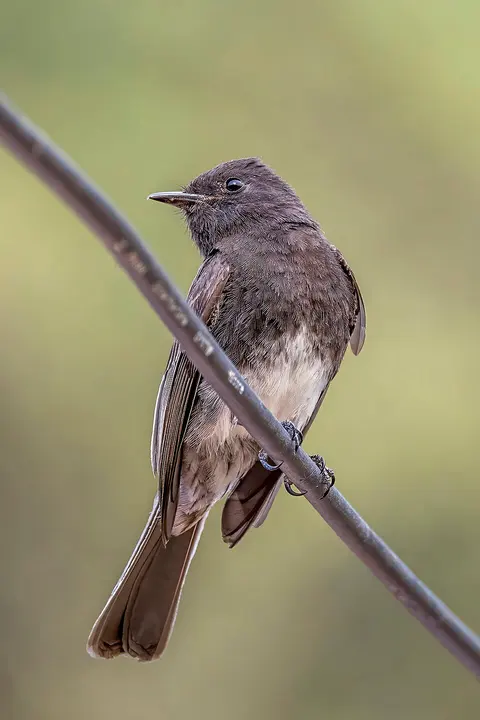
The black phoebe is a passerine bird in the tyrant-flycatcher family. It breeds from southwest Oregon and California south through Central and South America. It occurs year-round throughout most of its range and migrates less than the other birds in its genus though its northern populations are partially migratory.
Six subspecies are commonly recognized although two are occasionally combined as a separate species, the white-winged phoebe. The black phoebe has predominantly black plumage, with a white belly and undertail coverts. The sexes are identical in color, and juveniles have brown feather tips and brown wing-bars. Its song is a repeated tee-hee, tee ho. It lives in a variety of habitats but is always near water. It is mainly insectivorous and waits on a perch before sallying out and catching its prey in the air. It makes an open cup nest which is placed under a cliff or a bridge and cemented in its place with mud.
Appearance
The black phoebe is a medium-sized flycatcher, being 16 cm (6.3 in) in length and weighing 15 to 22 g (0.5 to 0.8 oz). It has predominantly black plumage, with white on its belly and undertail coverts. The white forms an inverted "V" in the lower breast. The sexes are identical and plumage does not vary seasonally. Juveniles have browner plumage, cinnamon-brown feather tips on their body, and brown wing-bars. The bird has brown irises and black legs, feet, and beak.
Habitat
The black phoebe breeds in the west and southwest United States, Mexico and Central America, and parts of South America. In Oregon it is found in river valleys on the Pacific coast, and in California on the western side of Coast Ranges. It breeds throughout the Colorado River valley and occasionally is found to the north in southern Nevada and southwestern Utah, as well as Arizona and central New Mexico.
Where the Black phoebe lives
Recorded in United States of America, Colombia and Mexico (North America and South America).
Most records fall in California, Arizona, Oregon, New Mexico, Texas and Nevada.
See the Black phoebe’s range on the globe
Conservation status
Least concern (LC). Not at risk: it is doing well in the wild. Categories are the IUCN Red List as republished by GBIF.
Sources
The range is a density of 3,775,824 georeferenced GBIF records, shown on the continents where it is mainly recorded, not an expert-drawn map. Description from Wikipedia.