Animals / Bird
Black-capped chickadee
Poecile atricapillus · Paridae
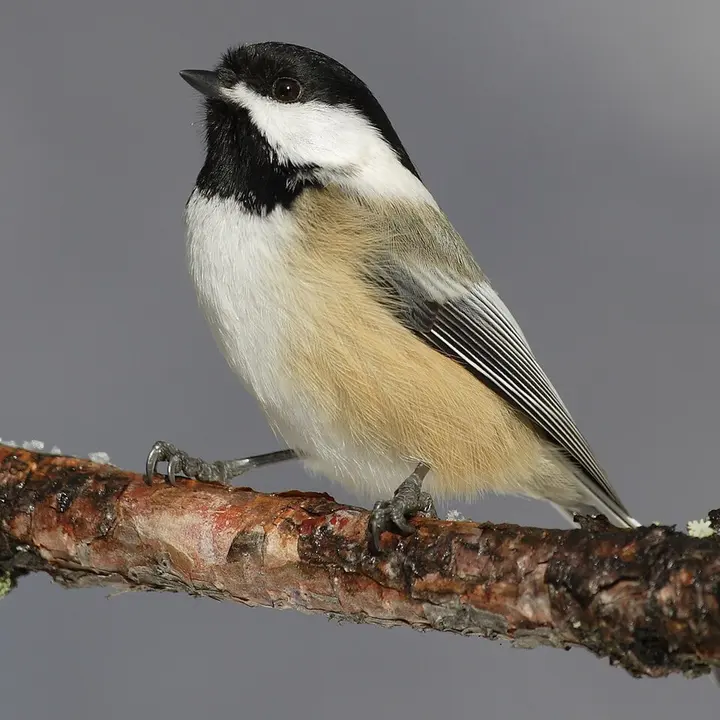
The black-capped chickadee is a small, nonmigratory, North American passerine bird that lives in deciduous and mixed forests. It is a member of the Paridae family, also known as tits. It has a distinct black cap on its head, a black bib underneath, and white cheeks.
It has a white belly, buff sides, and grey wings, back, and tail. The bird is well known for its vocalizations, including its fee-bee song and its chick-a-dee-dee-dee call, from which it derives its name. The black-capped chickadee is widely distributed throughout North America, ranging from the northern United States to southern Canada and all the way up to Alaska and Yukon. It feeds primarily on insects and seeds, and is known for its ability to cache food for use during the winter. The hippocampus of the black-capped chickadee grows during the caching season, which is believed to help it better remember its cache locations. The black-capped chickadee is a social bird and forms strict dominance hierarchies within its flock. During the winter, these flocks include other bird species.
Appearance
The black-capped chickadee has a black cap and "bib" with white cheeks. Its underparts are white with buff-coloured flanks. Its back is unstreaked and greenish grey, and the tail and wings are slate grey. It has a black beak and legs, and dark brown irises. Males and females are generally similar, although males have a larger bib. They can also be distinguished based on a combination of weight and tail length. Tarsus length does not significantly differentiate sexes.
Behaviour
The vocalizations of the black-capped chickadee are highly complex, with 16 distinct types of vocalizations being used to convey an array of information. These vocalizations are likely an evolutionary adaptation to their habitat; they live and feed in dense vegetation, and even when the flock is close together, individual birds tend to be out of each other's visual range. One of the most recognizable sounds produced, particularly by the males, is the two-note fee-bee song.
Habitat
Black-capped chickadees are non-migratory and can be found throughout much of North America. They range from western Alaska, through southern Yukon and throughout the Canadian provinces, from British Columbia in the west to the Maritimes and Newfoundland in the east.
Life cycle
Black-capped chickadees start to form breeding pairs in the late fall and into the winter. In the spring, the winter flocks will disperse into the constituent pairs. They are largely monogamous during this time, although occasionally males are observed mating with multiple females. Females prefer dominant males, and greater reproductive success is closely related to the higher ranking of the male.
Where the Black-capped chickadee lives
Recorded in United States of America and Canada (North America).
Most records fall in Ontario, Québec, New York, Massachusetts, Michigan and Wisconsin.
See the Black-capped chickadee’s range on the globe
Conservation status
Least concern (LC). Not at risk: it is doing well in the wild. Categories are the IUCN Red List as republished by GBIF.
Sources
The range is a density of 18,786,641 georeferenced GBIF records, shown on the continents where it is mainly recorded, not an expert-drawn map. Description from Wikipedia.