Animals / Mammal
Black-backed jackal
Canis mesomelas · Canidae
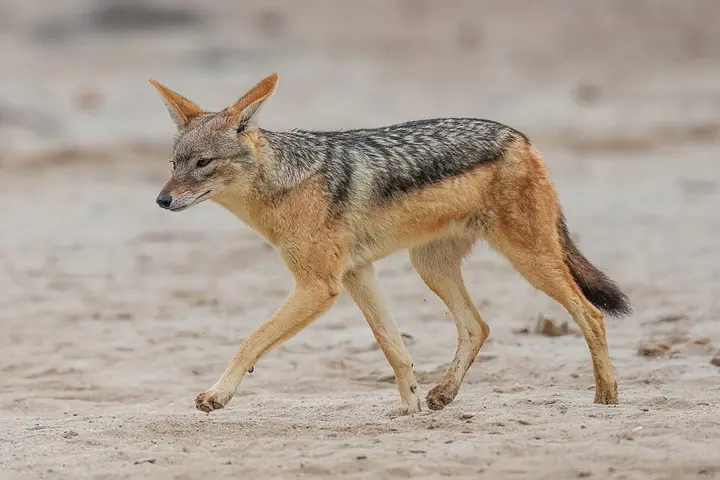
The black-backed jackal is a medium-sized canine native to eastern and southern Africa. These regions are separated by roughly 900 km (560 mi).
One region includes the southernmost tip of the continent, including South Africa, Namibia, Botswana and Zimbabwe. The other area is along the eastern coastline, including Kenya, Somalia, Djibouti, Eritrea, and Ethiopia. It is listed on the IUCN Red List as least concern due to its widespread range and adaptability, although it is still persecuted as a livestock predator and rabies vector. It has a reddish brown to tan coat and a black saddle that extends from the shoulders to the base of the tail. It is a monogamous animal, whose young may remain with the family to help raise new generations of pups. The black-backed jackal has a wide array of food sources, feeding on small to medium-sized animals, as well as plant matter and human refuse.
Appearance
The black-backed jackal is a fox-like canid with a slender body, long legs, and large ears. It is similar to the closely related side-striped jackal and more distantly related to the golden jackal, though its skull and dentition are more robust and the incisors much sharper. It weighs 6–13 kg (13–29 lb), stands 38–48 cm (15–19 in) at the shoulder, and measures 67.3–81.2 cm (26.5–32.0 in) in body length.
Behaviour
The black-backed jackal is a monogamous and territorial animal, whose social organisation greatly resembles that of the golden jackal. However, the assistance of elder offspring in helping raise the pups of their parents has a greater bearing on pup survival rates than in the latter species. This cooperative breeding behavior is a key component of their social structure, with older offspring often staying behind to support new litters rather than dispersing immediately.
Diet
Black-backed jackals are omnivores. Their diet includes invertebrates, such as beetles, grasshoppers, crickets, termites, millipedes, spiders, and scorpions. Mammals are eaten such as rodents, hares, and young antelopes up to the size of topi calves. They also feed on carrion, birds, bird eggs, lizards and snakes. In coastal areas, they feed on beached marine mammals, seals, fish, and mussels. They also consume occasionally fruits and berries.
Habitat
The black-backed jackal generally shows a preference for open areas with little dense vegetation, though it occupies a wide range of habitats, from arid coastal deserts to areas with more than 2000 mm of rainfall. In addition to their known range, black-backed jackals have demonstrated exceptional adaptability to human-altered landscapes, including agricultural fields and peri-urban zones.
Where the Black-backed jackal lives
Recorded in Namibia, Kenya, South Africa, Tanzania and Botswana (Africa).
Most records fall in Rift Valley, Oshikoto, Eastern, North-West, Arusha and Hardap.
See the Black-backed jackal’s range on the globe
Conservation status
Least concern (LC). Not at risk: it is doing well in the wild. Categories are the IUCN Red List as republished by GBIF.
Sources
The range is a density of 589 georeferenced GBIF records, shown on the continents where it is mainly recorded, not an expert-drawn map. Description from Wikipedia.