Animals / Mammal
Bighorn sheep
Ovis canadensis · Bovidae
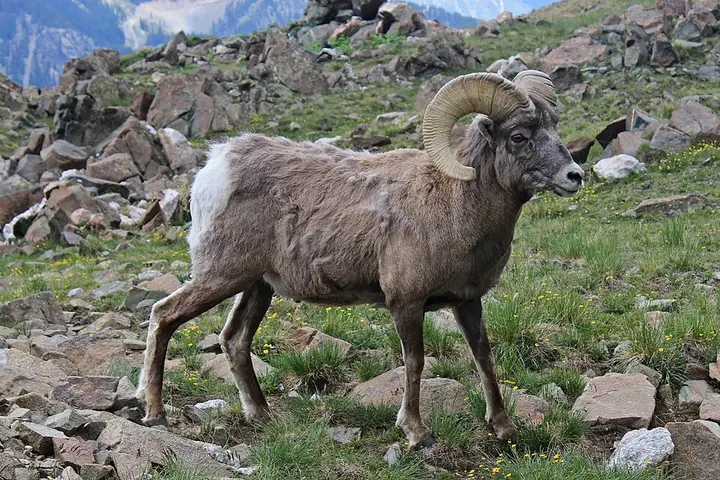
The bighorn sheep or bighorn is a species of sheep native to North America. It is named for its large horns, a pair of them may weigh up to 14 kg (30 lb); the sheep altogether typically weigh up to 143 kg (315 lb). Recent genetic testing indicates three distinct subspecies of Ovis canadensis, one of which is endangered: O. c. sierrae.
Sheep originally crossed to North America over the Bering Land Bridge from Siberia; the population in North America peaked in the millions, and the bighorn sheep entered into the mythology of Native Americans. By 1900, the population had crashed to several thousand due to diseases introduced through European livestock and overhunting.
Appearance
Bighorn sheep are named for the large, curved horns borne by the rams (males). Ewes (females) also have horns, but they are shorter and straighter. They range in color from light brown to grayish or dark, chocolate brown, with a white rump and lining on the backs of all four legs. Males typically weigh 58–143 kg (128–315 lb), are 90–105 cm (35–41 in; 2.95–3.44 ft) tall at the shoulder, and 1.6–1.85 m (63–73 in; 5.2–6.1 ft) long from the nose to the tail.
Behaviour
The Rocky Mountain and Sierra Nevada bighorn sheep occupy the cooler mountainous regions of Canada and the United States. In contrast, the desert bighorn sheep subspecies are indigenous to the hot desert ecosystems of the Southwestern United States and Mexico. Bighorn sheep inhabit alpine meadows, grassy mountain slopes, and foothill country near rugged, rocky cliffs and bluffs.
Where the Bighorn sheep lives
Recorded in United States of America, Canada and Mexico (North America).
Most records fall in California, Alberta, Colorado, Nevada, British Columbia and Montana.
See the Bighorn sheep’s range on the globe
Conservation status
Least concern (LC). Not at risk: it is doing well in the wild. Categories are the IUCN Red List as republished by GBIF.
Sources
The range is a density of 25,737 georeferenced GBIF records, shown on the continents where it is mainly recorded, not an expert-drawn map. Description from Wikipedia.