Animals / Mammal
Beluga whale
Delphinapterus leucas · Monodontidae
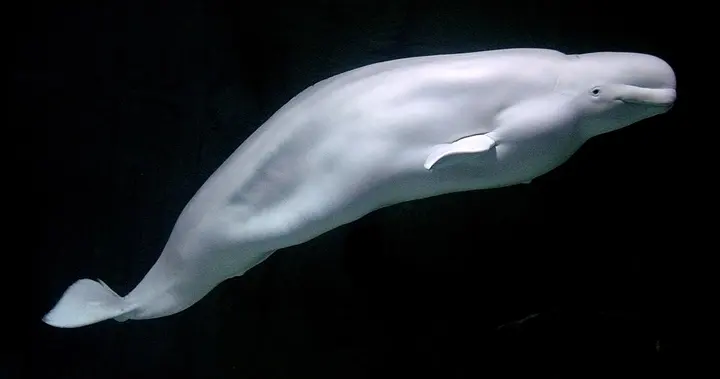
The beluga whale or the white whale is an Arctic and sub-Arctic cetacean. It is one of two living members of the family Monodontidae, along with the narwhal, and the only member of the genus Delphinapterus. It is also known as the sea canary, due to its high-pitched calls; and the melonhead, though that more commonly refers to the melon-headed whale, which is an oceanic dolphin.
The beluga is adapted to life in the Arctic, with anatomical and physiological characteristics that differentiate it from other cetaceans. Amongst these are its all-white colour that gives the whale its name; and the absence of a dorsal fin, which allows it to swim under ice with ease. It possesses a distinctive protuberance at the front of its head which houses an echolocation organ called the melon, which in this species is large and deformable. The beluga's body size is between that of a dolphin and a True's beaked whale, with males growing up to 5.5 m (18 ft) long and weighing up to 1,600 kg (3,530 lb). This whale has a stocky body. Like many cetaceans, a large percentage of its weight is blubber (subcutaneous fat).
Appearance
Belugas have a round and muscular body that is tapered at both ends. The tapering begins at the base of its neck, which gives the beluga the appearance of shoulders. This trait is unique compared to other cetaceans. Beluga whales do not have fused neck vertebrae. The neck of a beluga is narrower when compared to other extant whales. The unusual vertebrae traits in a beluga allow it to move its head and nod.
Behaviour
Belugas are highly sociable and they regularly form small groups, or pods, that may contain between two and 25 individuals, with an average of 10 members. Pods tend to be unstable, meaning individuals tend to move from pod to pod. Radio tracking has even shown belugas can start out in one pod and within a few days be hundreds of miles away from that pod.
Diet
Belugas play an important role in the structure and function of marine resources in the Arctic Ocean, as they are the most abundant toothed whales in the region. They are opportunistic feeders; their feeding habits depend on their locations and the season.
Habitat
The beluga inhabits a discontinuous circumpolar distribution in Arctic and sub-Arctic waters. During the summer, they can mainly be found in deep waters ranging from 76°N to 80°N, particularly along the coasts of Alaska, northern Canada, western Greenland and northern Russia. The southernmost extent of their range includes isolated populations in the St.
Life cycle
Estimations of the age of sexual maturity for beluga whales vary considerably; the majority of authors estimate males reach sexual maturity when they are between nine and fifteen years old, and females reach maturity between eight and fourteen years old.
Where the Beluga whale lives
Recorded in United States of America, Canada, Netherlands and Norway (North America and Europe).
Most records fall in Alaska, Québec, Noord-Holland, Manitoba, Northwest Territories and Nunavut.
See the Beluga whale’s range on the globe
Conservation status
Least concern (LC). Not at risk: it is doing well in the wild. Categories are the IUCN Red List as republished by GBIF.
Sources
The range is a density of 9,636 georeferenced GBIF records, shown on the continents where it is mainly recorded, not an expert-drawn map. Description from Wikipedia.