Animals / Mammal
Bat-eared fox
Otocyon megalotis · Canidae
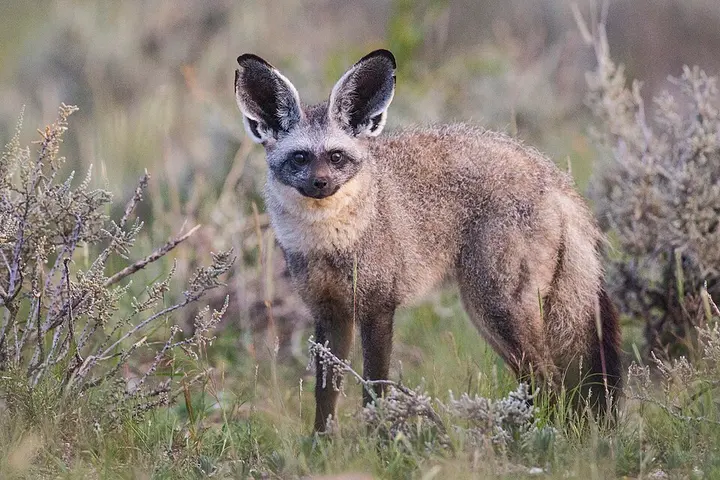
The bat-eared fox is a species of fox found on the African savanna. It is the only extant species of the genus Otocyon, and is the sister species to all other members of the tribe Vulpini, not genetically being a true fox. Fossil records indicate this canid first appeared during the middle Pleistocene.
There are two separate populations of the bat-eared fox, each of which makes up a subspecies. The bat referred to in its colloquial name is possibly the Egyptian slit-faced bat (Nycteris thebaica), which is abundant in the region and has very large ears. Other vernacular names include big-eared fox, black-eared fox, long-eared fox, Delalande's fox, cape fox, and motlosi. It is named for its large ears, which have a role in thermoregulation. It is a small canid, being of comparable size to the closely related cape fox and common raccoon dog. Its fur varies in color depending on the subspecies, but is generally tan-colored and has guard hairs of a grey agouti color.
Appearance
Bat-eared foxes range in weight from 3 to 5.3 kg (6.6 to 11.7 lb). Their head and body length is 46–66 cm (18–26 in), tail length is 23–34 cm (9.1–13 in), shoulder height is 30–40 cm (12–16 in), and the notably large ears are 11–13 cm (4.3–5.1 in) long. The species displays a degree of sexual dimorphism, in that females are generally larger and heavier than males. Generally, the pelage is tan-colored, with gray guard hairs of an agouti coloration.
Behaviour
Bat-eared foxes are social animals. They live in pairs or groups, depending on the subspecies. In southern Africa (ssp. megalotis), bat-eared foxes live in monogamous pairs with pups, while those in eastern Africa (ssp. virgatus) may live in pairs, or in stable family groups consisting of a male and up to three closely related females with pups. Individuals forage, play, and rest together in a group, which helps in protection against predators.
Habitat
The bat-eared fox has a disjunct distribution across the arid and semi-arid regions of Eastern and Southern Africa, in two allopatric populations (representing each of the recognized subspecies) separated by approximately 1,000 km (620 mi).
Life cycle
The bat-eared fox is predominantly socially monogamous, although it has been observed in polygynous groups. In contrast to other canids, the bat-eared fox has a reversal in parental roles, with the male taking on the majority of the parental care behavior. Gestation lasts for 60–70 days and females give birth to litters consisting of one to six pups.
Where the Bat-eared fox lives
Recorded in South Africa, Kenya, Namibia, Tanzania and Botswana (Africa).
Most records fall in Northern Cape, Western Cape, Rift Valley, Eastern Cape, Hardap and North-West.
See the Bat-eared fox’s range on the globe
Conservation status
Least concern (LC). Not at risk: it is doing well in the wild. Categories are the IUCN Red List as republished by GBIF.
Sources
The range is a density of 1,946 georeferenced GBIF records, shown on the continents where it is mainly recorded, not an expert-drawn map. Description from Wikipedia.