Animals / Bird
Barn swallow
Hirundo rustica · Hirundinidae
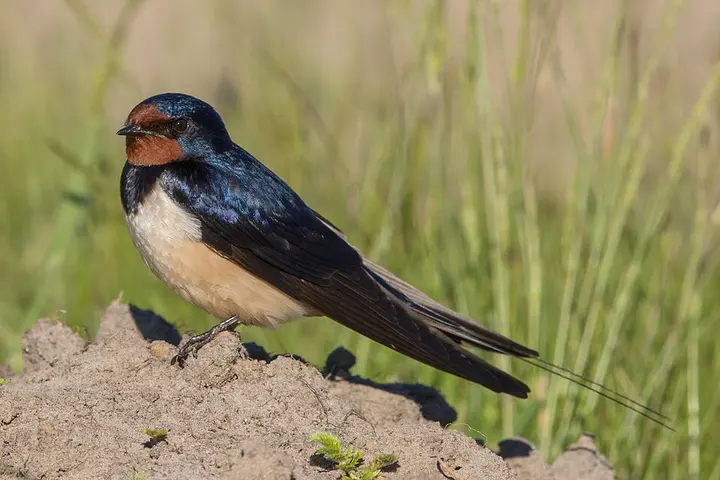
The barn swallow is the most widespread species of swallow in the world, occurring on all continents, with vagrants reported even in Antarctica. It is a distinctive passerine bird with blue upperparts and a long, deeply forked tail. In Anglophone Europe, it is just called the swallow; in northern Europe, it is the only member of family Hirundinidae called a "swallow" rather than a "martin".
There are eight subspecies of barn swallow, which breed across the Northern Hemisphere. Two subspecies (H. r. savignii and H. r. transitiva) have fairly restricted ranges in the Nile valley and eastern Mediterranean, respectively. The other six are more widespread, with winter ranges covering much of the Southern Hemisphere. The barn swallow is a bird of open country that normally nests in man-made structures and consequently has spread with human expansion. It builds a cup nest from mud pellets in barns or similar structures and feeds on insects caught in flight. This species lives in close association with humans, and its insect-eating habits mean that it is tolerated by humans; this acceptance was reinforced in the past by superstitions regarding the bird and its nest.
Appearance
The adult male barn swallow of the nominate subspecies H. r. rustica is 17–19 cm (6+1⁄2–7+1⁄2 in) long including 2–7 cm (1–3 in) of elongated outer tail feathers. It has a wingspan of 32–34.5 cm (12+1⁄2–13+1⁄2 in) and weighs 16–22 g (9⁄16–3⁄4 oz). It has steel blue upperparts and a rufous forehead, chin and throat, which are separated from the off-white underparts by a broad dark blue breast band.
Behaviour
The preferred habitat of the barn swallow is open country with low vegetation, such as pasture, meadows and farmland, preferably with nearby water. This swallow avoids heavily wooded or precipitous areas and densely built-up locations.
Diet
The barn swallow is similar in its habits to other aerial insectivores, including other swallow species and the unrelated swifts. It is not a particularly fast flier, with a speed estimated at 11 m/s (40 km/h), up to 20 m/s (72 km/h) and a wing beat rate of approximately 5, up to 7–9 times each second.
Life cycle
The male barn swallow returns to the breeding grounds before the females and selects a nest site, which is then advertised to females with a circling flight and song. Plumage may be used to advertise: in some populations, like in the subspecies H. r. gutturalis, darker ventral plumage in males is associated with higher breeding success.
Where the Barn swallow lives
Recorded in United States of America, Spain, Canada, Sweden, United Kingdom, France, Denmark, Finland, Netherlands, South Africa, Taiwan, Norway and India (North America, Europe, Africa and Asia).
Most records fall in Texas, California, New York, Ontario, Pennsylvania and Illinois.
See the Barn swallow’s range on the globe
Conservation status
Least concern (LC). Not at risk: it is doing well in the wild. Categories are the IUCN Red List as republished by GBIF.
Sources
The range is a density of 17,490,275 georeferenced GBIF records, shown on the continents where it is mainly recorded, not an expert-drawn map. Description from Wikipedia.