Animals / Bird
Baltimore oriole
Icterus galbula · Icteridae
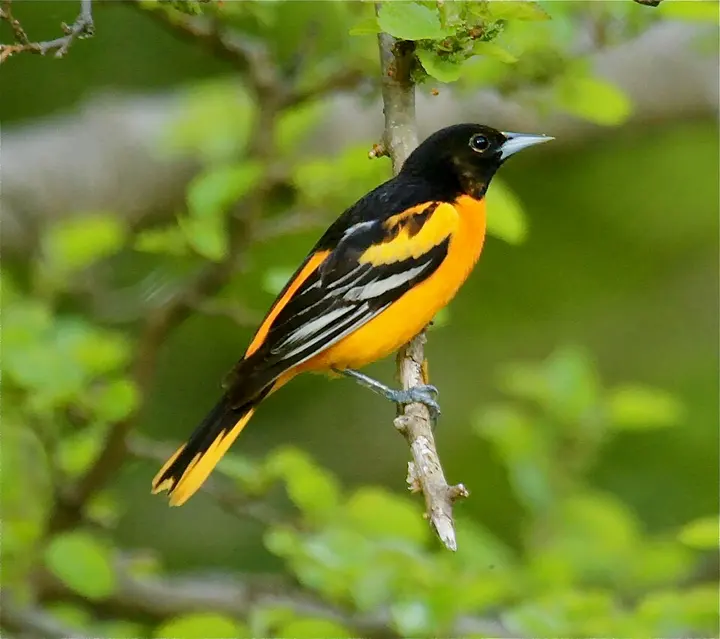
The Baltimore oriole is a small icterid blackbird common in eastern North America as a migratory breeding bird. It received its common name from the resemblance of the male's colors to those on the coat-of-arms of 17th-century Lord Baltimore. Observations of interbreeding between the Baltimore oriole and the western Bullock's oriole Icterus bullockii, led to both being classified as a single species, called the northern oriole, from 1973 to 1995.
Research by James Rising, a professor of zoology at the University of Toronto, and others showed that the two birds actually did not interbreed significantly. The Baltimore oriole is the state bird of Maryland, and the namesake and mascot for the Baltimore Orioles baseball team.
Appearance
This medium-sized passerine measures 17–22 cm (6.7–8.7 in) in length and spans 23–32 cm (9.1–12.6 in) across the wings. Their build is typical of icterids, as they have a sturdy body, a longish tail, fairly long legs and a thick, pointed bill. The body weight averages 33.8 g (1.19 oz), with a range of weights from 22.3 to 42 g (0.79 to 1.48 oz). The male oriole is slightly larger than the female, although the size dimorphism is minimal by icterid standards.
Behaviour
The Baltimore orioles' song is a short set of recognizable, sweet whistles that sound like "tyew, pyeer, peededoo, and "teer." Calls include "veeer," which is an unusual nasal sound, a low chatter call, and two high calls which sound like "tyew-li and kleek." The male Baltimore oriole song is a clear whistle with a vibrant tone that flows and includes a brief sequence of notes that are paired and repeated 2-7 times, lasting 1-2 seconds.
Diet
Baltimore orioles forage in trees and shrubs, also making short flights to catch insects. They acrobatically clamber, hover, and hang among foliage as they comb high branches. They mainly eat insects, berries, and nectar, and are often seen sipping at hummingbird feeders. Their favored prey is perhaps the forest tent caterpillar moth, which they typically eat in their larval stage, and can be a nuisance species if not naturally regulated by predation.
Habitat
Baltimore orioles live in the Nearctic in summer, including the Canadian Prairies and eastern Montana in the northwest eastward through southern Ontario, southern Quebec and New Brunswick and south through the eastern United States to central Mississippi and Alabama and northern Georgia. They migrate to winter in the Neotropics as far north as Mexico and sometimes the southern coast of the United States, but predominantly in Central America and northern South America.
Life cycle
Baltimore orioles are basically solitary outside their mating season. The species is generally considered monogamous, although evidence suggests that extra-pair copulation is relatively common. In the spring, males establish a territory and then display to females by singing and chattering while hopping from perch to perch in front of them. Males also give a bow display, bowing with wings lowered and tail fanned.
Where the Baltimore oriole lives
Recorded in United States of America, Canada and Costa Rica (North America).
Most records fall in Ontario, New York, Ohio, Michigan, Massachusetts and Pennsylvania.
See the Baltimore oriole’s range on the globe
Conservation status
Least concern (LC). Not at risk: it is doing well in the wild. Categories are the IUCN Red List as republished by GBIF.
Sources
The range is a density of 4,301,464 georeferenced GBIF records, shown on the continents where it is mainly recorded, not an expert-drawn map. Description from Wikipedia.