Animals / Mammal
Bactrian camel
Camelus bactrianus · Camelidae
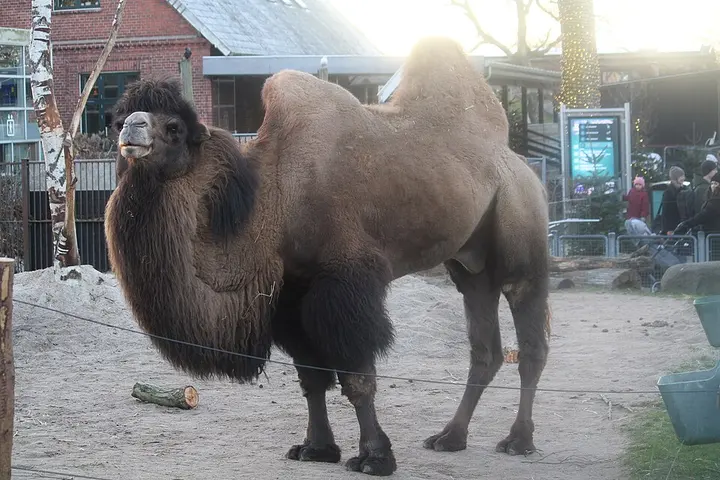
The Bactrian camel, also known as the Mongolian camel, domestic Bactrian camel, two-humped camel or double-humped camel, is a camel native to the steppes of Central Asia. It has two humps on its back, in contrast to the single-humped dromedary. Its population of 2 million exists mainly in the domesticated form.
Their name comes from the ancient historical region of Bactria. The domesticated Bactrian camel has served as pack animals in inner Asia since ancient times. With its tolerance for cold, drought, and high altitudes, it enabled the travel of caravans on the Silk Road. Bactrian camels, whether domesticated or feral, are a separate species from the wild Bactrian camel (Camelus ferus), which is the only truly wild (as opposed to feral) species of camelid in the Old World. Domestic Bactrian camels do not descend from wild Bactrian camels, with the two species having split around 1 million years ago.
Appearance
The Bactrian camel is the largest mammal in its native range and is the largest living camel while being shorter at the shoulder than the dromedary. Shoulder height is from 160 to 180 cm (5.2 to 5.9 ft) with the overall height ranging from 230 to 250 cm (7.5 to 8.2 ft), head-and-body length is 225–350 cm (7.38–11.48 ft), and the tail length is 35–55 cm (14–22 in). At the top of the humps, the average height is 213 cm (6.99 ft).
Diet
Bactrian camels are diurnal, sleeping in the open at night and foraging for food during the day. They are primarily herbivorous and constantly graze on grasses. With tough mouths that can withstand sharp objects such as thorns, they are able to eat plants that are dry, prickly, salty or bitter, and can ingest virtually any kind of vegetation.
Life cycle
Bactrian camels are exceptionally adept at withstanding wide variations in temperature, ranging from freezing cold to blistering heat. They can go without water for months at a time, but when water is available they may drink up to 57 L (13 imp gal; 15 US gal). A thirsty camel in a hot dry season can drink up to 200 L (44 imp gal; 53 US gal) of water in one day. When well fed, the humps are plump and erect, but as resources decline, they shrink and lean to the side.
Where the Bactrian camel lives
Recorded in Mongolia, China, Russia, India, Kyrgyzstan, Uzbekistan and Afghanistan (Asia).
Most records fall in Ömnögovi, Gorno-Altay, Hovd, Xinjiang, Inner Mongol and Dundgovi.
See the Bactrian camel’s range on the globe
Conservation status
Not evaluated (NE). Scientists haven’t checked yet how at risk it is, so this doesn’t mean it is safe or in danger. Categories are the IUCN Red List as republished by GBIF.
Sources
The range is a density of 276 georeferenced GBIF records, shown on the continents where it is mainly recorded, not an expert-drawn map. Description from Wikipedia.