Animals / Mammal
Aye-aye
Daubentonia madagascariensis · Daubentoniidae
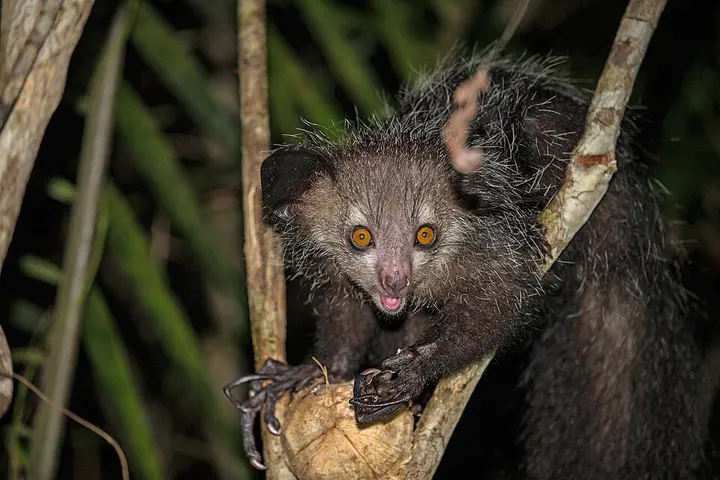
The aye-aye is a long-fingered lemur, a strepsirrhine primate native to Madagascar with rodent-like teeth that perpetually grow and a special thin middle finger that they can use to catch grubs and larvae out of tree trunks.
It is the world's largest nocturnal primate. It is characterized by its unusual method of finding food: It taps on trees and listens for echoes that signal hollows inside them, which are often infested by grubs, then gnaws holes into the wood using its forward-slanting incisors to create a small hole into which it inserts its narrow middle finger to pull the grubs out. This foraging method is called percussive foraging, and takes up 5–41% of the aye-aye's foraging time. The only other living mammal species known to find food in this way are the striped possum and trioks (genus Dactylopsila) of northern Australia and New Guinea, which are marsupials.
Appearance
A full-grown aye-aye is typically about 60 centimetres (2 feet) long with a tail longer than its body. The species has an average head and body length of 36–43 cm (14–17 in) plus a tail of 56–61 cm (22–24 in), and weighs around 2 kilograms (4 pounds). Young aye-ayes typically are silver colored on their front and have a stripe down their back.
Habitat
The aye-aye lives primarily on the east coast of Madagascar. Its natural habitat is rainforest or dry deciduous forest, but many live in cultivated areas due to deforestation. Rainforest aye-ayes, the most common, dwell in canopy areas, and are usually sighted above 70 meters altitude. They sleep during the day in nests built from interwoven twigs and dead leaves up in the canopy among the vines and branches.
Where the Aye-aye lives
Recorded in Madagascar (Africa).
Most records fall in Atsinanana, Sava, Vatovavy-Fitovinany, Analanjirofo, Itasy and Alaotra-Mangoro.
See the Aye-aye’s range on the globe
Conservation status
Endangered (EN). In danger of dying out in the wild. Categories are the IUCN Red List as republished by GBIF.
Sources
The range is a density of 156 georeferenced GBIF records, shown on the continents where it is mainly recorded, not an expert-drawn map. Description from Wikipedia.