Animals / Amphibian
Axolotl
Ambystoma mexicanum · Ambystomatidae
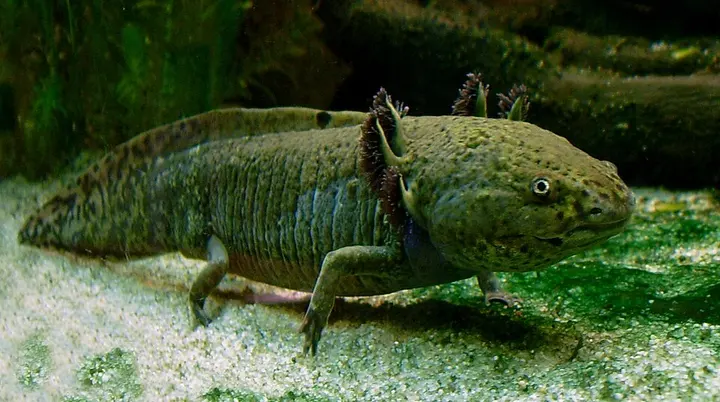
The axolotl is a species of mole salamander. It is neotenic, reaching sexual maturity without undergoing metamorphosis, and the adults remain fully aquatic with obvious external gills. Axolotls may be difficult to distinguish from the larval stage of other neotenic adult mole salamanders, in particular the tiger salamander, or other species such as mudpuppies.
Axolotls originally inhabited a system of interconnected wetlands and lakes in the highlands of Mexico. They were known to inhabit the smaller lakes of Xochimilco and Chalco and are presumed to have inhabited the larger lakes of Texcoco and Zumpango. The desiccation of these lakes, initiated by the Aztecs and accelerated during the 20th century, has led to the destruction of much of the axolotl's natural habitat, an area now largely occupied by Mexico City.
Appearance
A sexually mature adult axolotl, at age 18–27 months, ranges in length from 15 to 45 cm (6 to 18 in); a size close to 23 cm (9 in) is most common, and any greater than 30 cm (12 in) is rare. Axolotls possess features typical of salamander larvae, including external gills and a caudal fin extending from behind the head to the vent. Unlike most salamander species, axolotls retain their external gills when they mature into adulthood. This is a type of neoteny.
Where the Axolotl lives
Recorded in Mexico (North America).
Most records fall in Distrito Federal, México, Zacatecas, Michoacán, San Luis Potosí and Chihuahua.
See the Axolotl’s range on the globe
Conservation status
Critically endangered (CR). In very great danger of dying out in the wild. Categories are the IUCN Red List as republished by GBIF.
Sources
The range is a density of 332 georeferenced GBIF records, shown on the continents where it is mainly recorded, not an expert-drawn map. Description from Wikipedia.