Animals / Amphibian
Australian green tree frog
Ranoidea caerulea · Pelodryadidae
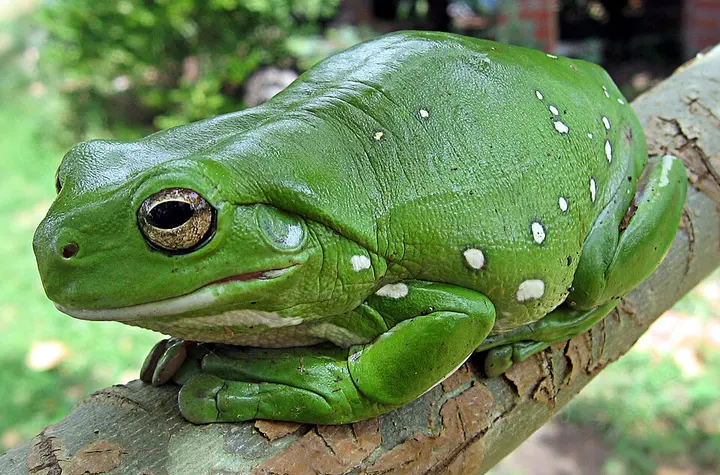
The Australian green tree frog, also known as simply green tree frog in Australia, White's tree frog, or dumpy tree frog, is a species of tree frog native to Australia and New Guinea, with introduced populations in the United States and New Zealand, though the latter is believed to have died out. It is morphologically similar to some other members of its family, particularly the magnificent tree frog (P. splendida) and the white-lipped tree frog.
Larger than most Australian frogs, the Australian green tree frog reaches 10 cm (4 in) or more in length. Its average lifespan in captivity, about 16 years, is long compared with most frogs. Docile and well suited to living near human dwellings, Australian green tree frogs are often found on window sills or inside houses, eating insects drawn by the light. The green tree frog screams when it is in danger to scare off its foe, and squeaks when it is touched. Due to its appearance and behavioural traits, the green tree frog is a popular exotic pet throughout the world.
Appearance
The green tree frog is a plump, rather large tree frog, and can grow up to 11.5 cm (4.5 in) in length, with fully grown females being slightly larger than males. A distinctive fatty ridge is seen over the eye, and the parotoid gland is moderately large. The iris is golden and has a horizontally slit pupil, and the tympanum (a skin membrane similar to an eardrum) is visible just behind the eye. Selective breeding has also resulted in blue irises.
Behaviour
Australian green tree frogs are very docile and unafraid of humans. They are nocturnal and come out in early evenings to call (in spring and summer) and hunt for food. During the day, they find cool, dark, and moist areas, such as tree holes or rock crevices, in which to sleep. They are not a rainforest species, but make use of the rain that falls almost daily and collects on leaves and in crevices, to keep themselves moist.
Habitat
The green tree frog is native to northern and eastern regions of Australia and to the lowlands of New Guinea. Distribution is limited mostly to areas with warm, wet tropical climates. Its range spans from Irian Jaya to Port Moresby, and is most abundant on Daru Island. The IUCN suggests "scattered locations" in both New Guinea and Indonesia.
Life cycle
Breeding occurs between November and February. During the mating season, the males call from slightly elevated positions close to the still-water sources in which they choose to breed. Clumps of between 200 and 2000 eggs are laid which initially float, but sink within 24 hours. The development of the tadpoles takes about six weeks, after which they undergo metamorphosis and leave the water as juvenile frogs.
Where the Australian green tree frog lives
Recorded in Ashmore and Cartier Is. and Papua New Guinea (Oceania).
Most records fall in New South Wales, Queensland, Northern Territory, Western Australia, Western and National Capital District.
See the Australian green tree frog’s range on the globe
Conservation status
Least concern (LC). Not at risk: it is doing well in the wild. Categories are the IUCN Red List as republished by GBIF.
Sources
The range is a density of 22,104 georeferenced GBIF records, shown on the continents where it is mainly recorded, not an expert-drawn map. Description from Wikipedia.