Animals / Jellyfish
Australian box jellyfish
Chironex fleckeri · Chirodropidae
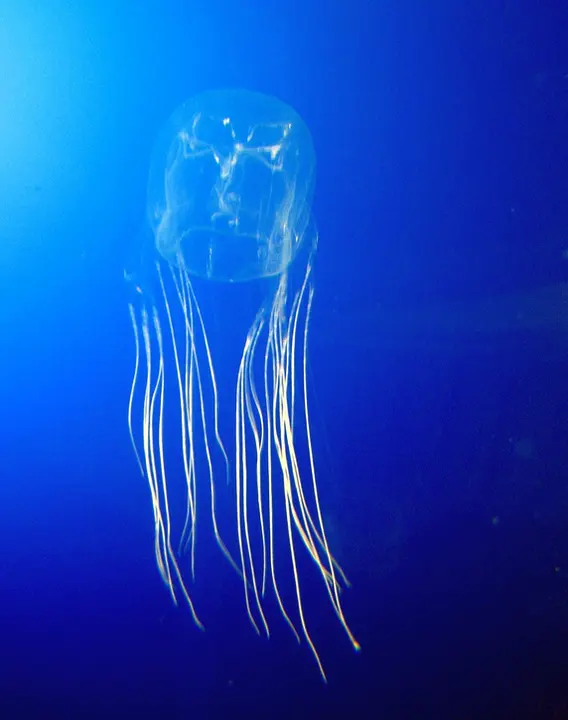
Chironex fleckeri, commonly known as the Australian box jelly and nicknamed the sea wasp, is a species of extremely venomous box jellyfish found in coastal waters from northern Australia and Papua New Guinea to Indonesia, East Timor, Cambodia, Malaysia, Singapore, the Philippines and Vietnam. It has been described as "the most lethal jellyfish in the world", with at least 64 known deaths in Australia from 1884 to 2021.
Notorious for its sting, C. fleckeri has tentacles up to 3 m (10 ft) long covered with millions of cnidocytes which, on contact, release microscopic darts delivering an extremely powerful venom. Being stung commonly results in excruciating pain, and if the sting area is significant, an untreated victim may die in two to five minutes. The amount of venom in one animal is said to be enough to kill 60 adult humans.
Appearance
Chironex fleckeri is the largest of the cubozoans (collectively called box jellyfish), many of which may carry similarly toxic venom. Its bell usually reaches about 16 cm (6.3 in) in diameter but can grow up to 35 cm (14 in). From each of the four corners of the bell trails a cluster of 15 tentacles. The pale blue bell has faint markings; viewed from certain angles, it bears a somewhat eerie resemblance to a human head or skull.
Habitat
The medusa is pelagic and has been documented from coastal waters of Australia and New Guinea north to the Philippines, Malaysia, Singapore and Vietnam. In Australia, it is known from the northern coasts from Exmouth to Agnes Water, but its full distribution outside Australia has not been properly identified. The closely related and also dangerously venomous Chironex yamaguchii was first described from Japan in 2009.
Life cycle
Chironex fleckeri is capable of both sexual and asexual reproduction and are oviparous.
Where the Australian box jellyfish lives
Recorded in Ashmore and Cartier Is. (Oceania).
Most records fall in Queensland, Northern Territory, Western Australia and New South Wales.
See the Australian box jellyfish’s range on the globe
Conservation status
Not evaluated (NE). Scientists haven’t checked yet how at risk it is, so this doesn’t mean it is safe or in danger. Categories are the IUCN Red List as republished by GBIF.
Sources
The range is a density of 174 georeferenced GBIF records, shown on the continents where it is mainly recorded, not an expert-drawn map. Description from Wikipedia.