Animals / Bird
Atlantic puffin
Fratercula arctica · Alcidae
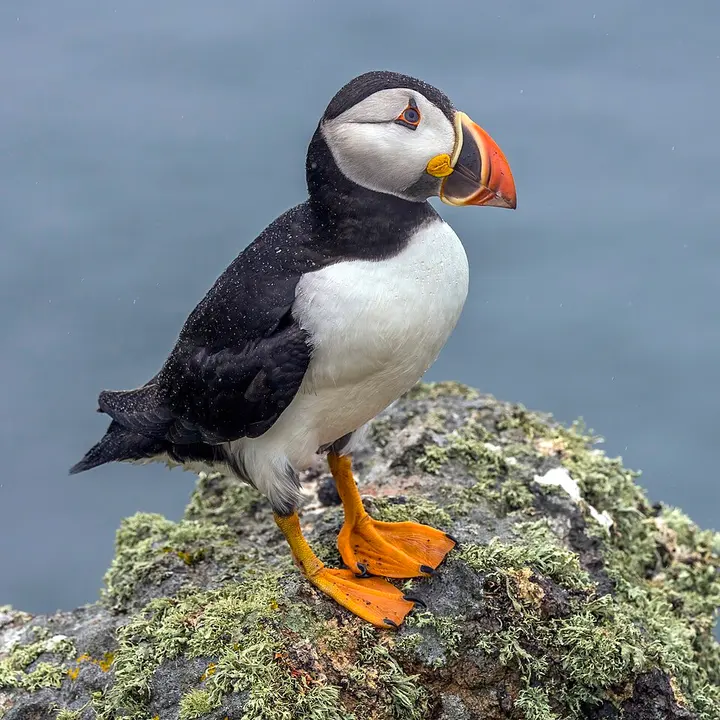
The Atlantic puffin, also known as the common puffin, is a species of seabird in the auk family. It is the only puffin native to the Atlantic Ocean; two related species, the tufted puffin and the horned puffin, are found in the northeastern Pacific. The Atlantic puffin breeds in Russia, Iceland, Ireland, Britain, Norway, Greenland, Newfoundland and Labrador, Nova Scotia, and the Faroe Islands, and as far south as Maine in the west and France (Brittany).
It is most commonly found in the Westman Islands, Iceland. Although it has a large population and a wide range, the species has declined rapidly, at least in parts of its range, resulting in it being rated as vulnerable by the IUCN. On land, it has the typical upright stance of an auk. At sea, it swims on the surface and feeds on zooplankton, small fish, and crabs, which it catches by diving underwater, using its wings for propulsion. This puffin has a black crown and back, light grey cheek patches, and a white body and underparts. Its broad, boldly marked red-and-black beak and orange legs contrast with its plumage. It moults while at sea in the winter, and some of the brightly coloured facial characteristics are lost, with colour returning during the spring.
Appearance
The Atlantic puffin is sturdily built with a thick-set neck and short wings and tail. It is 28 to 30 cm (11 to 12 in) in length from the tip of its stout bill to its blunt-ended tail. Its wingspan is 47 to 63 cm (19 to 25 in) and on land it stands about 20 cm (8 in) high. The male is generally slightly larger than the female, but they are coloured alike. The forehead, crown, and nape are glossy black, as are the back, wings, and tail.
Behaviour
Like many seabirds, the Atlantic puffin spends most of the year far from land in the open ocean and visits coastal areas only to breed. It is a sociable bird, and it usually breeds in large colonies.
Diet
Historically, Atlantic puffins were caught and eaten fresh, salted in brine, or smoked and dried. Their feathers were used in bedding, and their eggs were eaten, but not to the same extent as those of some other seabirds, being more difficult to extract from the nest. In most countries, Atlantic puffins are now protected by legislation, and in the countries where hunting is still permitted, strict laws prevent overexploitation.
Habitat
The Atlantic puffin is a bird of the colder waters of the North Atlantic Ocean. It breeds on the coasts of northwest Europe, the Arctic fringes, and eastern North America. More than 90% of the global population is found in Europe (4,770,000–5,780,000 pairs, equalling 9,550,000–11,600,000 adults) and colonies in Iceland alone are home to 60% of the world's Atlantic puffins.
Where the Atlantic puffin lives
Recorded in United Kingdom, United States of America, Canada, Norway, Iceland, Faeroe Is., Sweden and Ireland (Europe and North America).
Most records fall in Maine, Shetland Islands, Eilean Siar, Highland, North Yorkshire and Fife.
See the Atlantic puffin’s range on the globe
Conservation status
Vulnerable (VU). At risk: it could become endangered. Categories are the IUCN Red List as republished by GBIF.
Sources
The range is a density of 303,609 georeferenced GBIF records, shown on the continents where it is mainly recorded, not an expert-drawn map. Description from Wikipedia.