Animals / Fish
Atlantic bluefin tuna
Thunnus thynnus · Scombridae
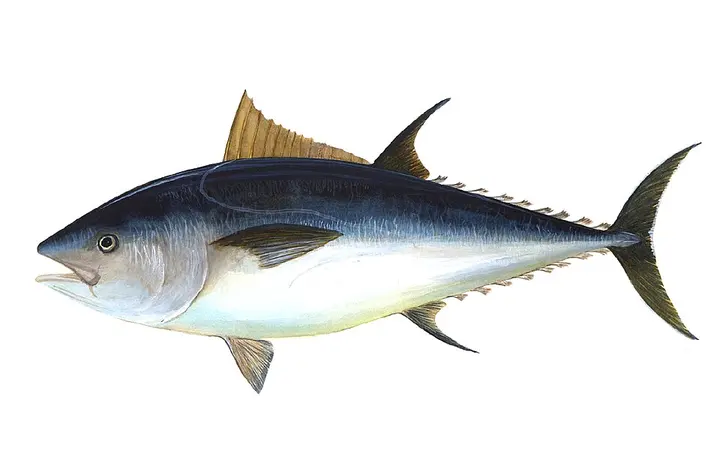
The Atlantic bluefin tuna is a species of tuna in the family Scombridae. It is variously known as the northern bluefin tuna, giant bluefin tuna, and formerly as the tunny.
Atlantic bluefins are native to both the western and eastern Atlantic Ocean, as well as the Mediterranean Sea. They have become regionally extinct in the Black Sea. The Atlantic bluefin tuna is a close relative of one of the other two bluefin tuna species, the Pacific bluefin tuna. The southern bluefin tuna, on the other hand, is more closely related to other tuna species such as yellowfin tuna and bigeye tuna, and the similarities between the southern and northern species are due to convergent evolution. Atlantic bluefin tuna have been recorded at up to 680 kg (1,500 lb) in weight, and rival the black marlin, blue marlin, and swordfish as one of the largest Percomorpha (though these species are vastly outweighed by the enormous Molidae species).
Appearance
The body of the Atlantic bluefin tuna is rhomboidal in profile and robust. The head is conical and the mouth rather large. The head contains a "pineal window" that allows the fish to navigate over its multiple thousands-of-miles range. Their color is dark blue above and gray below, with a gold coruscation covering the body and bright yellow caudal finlets. Bluefin tuna can be distinguished from other family members by the relatively short length of their pectoral fins.
Life cycle
Bluefin tuna are oviparous, congregating together in large groups to spawn. Over several days, a female releases large numbers of eggs into the water where they are fertilized externally by male sperm. Female bluefins have been estimated to produce a mean of 128.5 eggs per gram of body weight, or up to 40 million eggs at a time. Eggs hatch into larvae two days after fertilization and become cannibalistic quarter-inch long fish by the end of a week.
Where the Atlantic bluefin tuna lives
Recorded in United States of America, Sweden, France and Spain (North America and Europe).
Most records fall in New York, Skåne, North Carolina, Florida, Alicante and Bouches-du-Rhône.
See the Atlantic bluefin tuna’s range on the globe
Conservation status
Least concern (LC). Not at risk: it is doing well in the wild. Categories are the IUCN Red List as republished by GBIF.
Sources
The range is a density of 9,299 georeferenced GBIF records, shown on the continents where it is mainly recorded, not an expert-drawn map. Description from Wikipedia.