Animals / Mammal
Asian elephant
Elephas maximus · Elephantidae
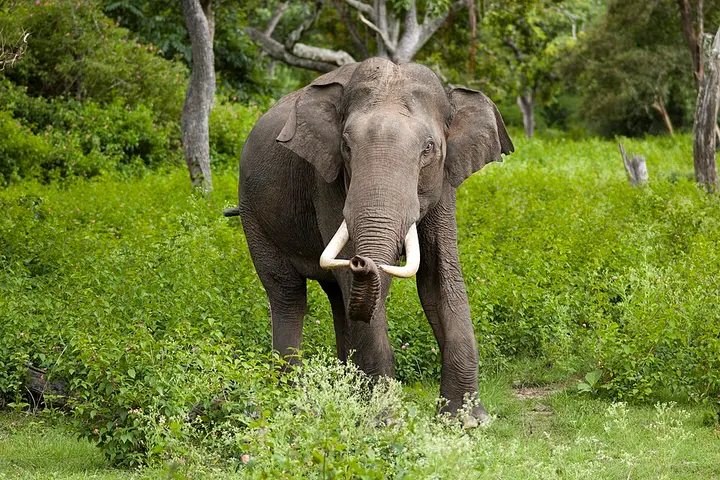
The Asian elephant, also known as the Asiatic elephant, is the only living species in the genus Elephas. It is the largest living land animal in Asia and the second largest living elephantid in the world. It is characterised by its long trunk with a single finger-like process; large tusks in males; laterally folded large ears and wrinkled grey skin that is partly depigmented on the trunk, ears or neck.
Adult males average 4 t (4.4 short tons) in weight and females 2.7 t (3.0 short tons). It has a large and well developed neocortex of the brain, is highly intelligent and self-aware, being able to display behaviours associated with grief, learning and greeting. Three subspecies are recognised—E. m. maximus, E. m. indicus and E. m. sumatranus. The Asian elephant is distributed in the Indian subcontinent and Southeast Asia, from India in the west to Borneo in the east, and Nepal in the north to Sumatra in the south. It inhabits grasslands, tropical evergreen forests, semi-evergreen forests, moist deciduous forests, dry deciduous forests and dry thorn forests. It is herbivorous, eating about 150 kg (330 lb) of vegetation per day.
Appearance
In general, the Asian elephant is smaller than the African bush elephant and has the highest body point on the head. The back is convex or level. The ears are small with dorsal borders folded laterally. It has up to 20 pairs of ribs and 34 caudal vertebrae. The feet have five nail-like structures on each forefoot, and four on each hind foot. The forehead has two hemispherical bulges, unlike the flat front of the African elephants.
Behaviour
Asian elephants are crepuscular. They are classified as megaherbivores and consume up to 150 kg (330 lb) of plant matter per day. Around 50 to 75% of the day is devoted to eating. They are generalist feeders, and are both grazers and browsers. They are known to feed on at least 112 different plant species, most commonly of the order Malvales, as well as the legume, palm, sedge and true grass families.
Habitat
Asian elephants are distributed throughout the Indian subcontinent and Southeast Asia, from India in the west, to Borneo in the east, and Nepal in the north, to Sumatra in the south. They inhabit grasslands, tropical evergreen forests, semi-evergreen forests, moist deciduous forests, dry deciduous forests and dry thorn forests, in addition to cultivated and secondary forests and scrublands.
Life cycle
Reproduction in Asian elephants can be attributed to the production and perception of signaling compounds called pheromones. These signals are transmitted through various bodily fluids. They are commonly released in urine but in males they are also found in special secretions from the temporal glands. Once integrated and perceived, these signals provide the receiver with information about the reproductive status of the sender.
Where the Asian elephant lives
Recorded in India, Sri Lanka, Thailand, Malaysia, Cambodia and Nepal (Asia).
Most records fall in Kerala, Mŏṇarāgala, Sabah, Tamil Nadu, Karnataka and Assam.
See the Asian elephant’s range on the globe
Conservation status
Endangered (EN). In danger of dying out in the wild. Categories are the IUCN Red List as republished by GBIF.
Sources
The range is a density of 7,217 georeferenced GBIF records, shown on the continents where it is mainly recorded, not an expert-drawn map. Description from Wikipedia.