Animals / Mammal
Arctic fox
Vulpes lagopus · Canidae
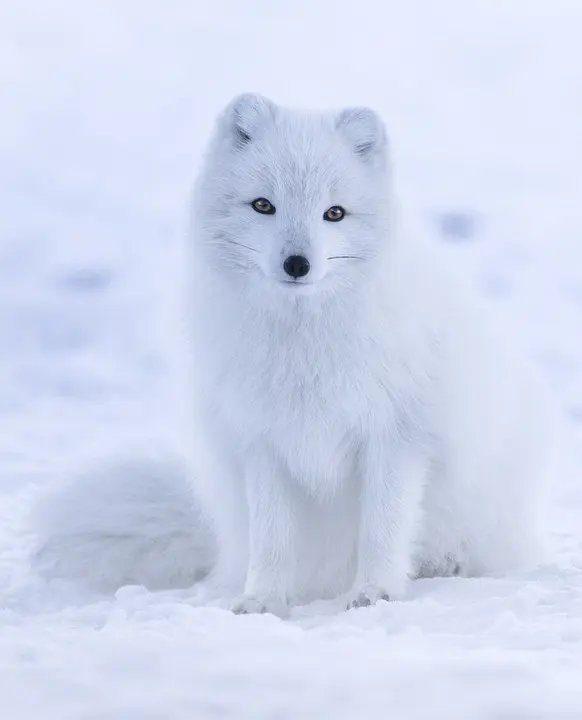
The Arctic fox, also known as the white fox, polar fox, or snow fox, is a small species of fox native to the Arctic regions of the Northern Hemisphere and common throughout the Arctic tundra. It is well adapted to living in cold environments, and is known for its thick, warm fur that can be used as camouflage against snow in the winter. It has a large and fluffy tail.
In the wild, most individuals do not live past their first year but some exceptional ones survive up to 11 years. Its body length ranges from 46 to 68 cm (18 to 27 in), with a generally rounded body shape to minimize the escape of body heat. The Arctic fox preys on many small creatures such as lemmings, voles, ringed seal pups, fish, waterfowl, and seabirds. It also eats carrion, berries, seaweed, and insects and other small invertebrates. Arctic foxes form monogamous pairs during the breeding season and they stay together to raise their young in complex underground dens. Occasionally, other family members may assist in raising their young. Natural predators of the Arctic fox include golden eagles, Arctic wolves, polar bears, wolverines, red foxes, and brown bears.
Appearance
The Arctic fox is smaller than the red fox, standing 25–30 cm (9.8–11.8 in) tall at the shoulder. Males weigh 3.5 kg (7.7 lb) on average, with a range of 3.2–9.4 kg (7.1–20.7 lb), while females average 2.9 kg (6.4 lb), with a range of 1.4–3.2 kg (3.1–7.1 lb). The average head-to-rear length of males is 55 cm (22 in), ranging from 46–68 cm (18–27 in), while females average 52 cm (20 in) with a range of 41–55 cm (16–22 in).
Behaviour
Arctic foxes must endure a temperature difference of up to 90–100 °C (160–180 °F) between the external environment and their internal core temperature. To prevent heat loss, the Arctic fox curls up tightly tucking its legs and head under its body and behind its furry tail. This position gives the fox the smallest surface area to volume ratio and protects the least insulated areas. Arctic foxes also stay warm by getting out of the wind and residing in their dens.
Diet
Arctic foxes generally eat any small animal they can find, including lemmings, voles, other rodents, hares, birds, eggs, fish, and carrion. They scavenge on carcasses left by larger predators such as wolves and polar bears, and in times of scarcity also eat their feces. In areas where they are present, lemmings are their most common prey, and a family of foxes can eat dozens of lemmings each day.
Habitat
The Arctic fox has a circumpolar distribution and occurs in Arctic tundra habitats in northern Europe, northern Asia, and North America. Its range includes Iceland, Fennoscandia, Svalbard, and other islands in the Barents Sea, northern Russia, islands in the Bering Sea, Greenland, Alaska, and Canada as far south as Hudson Bay. In the late 19th century, it was introduced into the Aleutian Islands southwest of Alaska.
Where the Arctic fox lives
Recorded in United States of America, Canada, Norway, Russia, Iceland, Greenland and Finland (North America, Europe and Asia).
Most records fall in Alaska, Nunavut, Svalbard, Nordland, Sør-Trøndelag and Vesturland.
See the Arctic fox’s range on the globe
Conservation status
Least concern (LC). Not at risk: it is doing well in the wild. Categories are the IUCN Red List as republished by GBIF.
Sources
The range is a density of 10,735 georeferenced GBIF records, shown on the continents where it is mainly recorded, not an expert-drawn map. Description from Wikipedia.