Animals / Bird
Anna's hummingbird
Calypte anna · Trochilidae
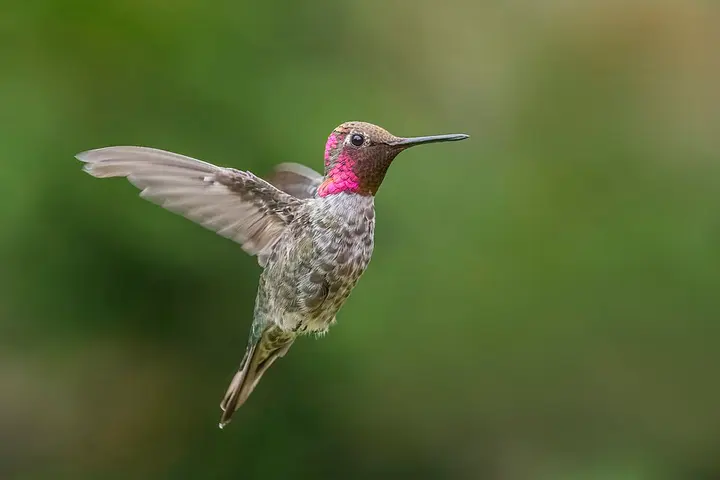
Anna's hummingbird is a North American species of hummingbird named after Anna Masséna, Duchess of Rivoli.
It is native to western coastal regions of North America. Until the late 20th century, Anna's hummingbirds migrated from locations as far north as Alaska and coastal British Columbia, returning south to breed in Baja California and Southern California. Since the 1970s, ornamental plants in residential areas along the Pacific coast and inland deserts provided expanded nectar and nesting sites, allowing the species to expand its breeding range to northern coastal regions without migrating. Year-round residence of Anna's hummingbirds in the Pacific Northwest is an example of ecological release dependent on acclimation to colder winter temperatures, introduced plants, and human provision of nectar feeders during winter. These birds feed on nectar from flowers using a long extendable tongue.
Appearance
Anna's hummingbirds are 3.9 to 4.3 in (9.9 to 10.9 cm) long with a wingspan of 4.7 inches (12 cm) and a weight range of 0.1 to 0.2 oz (2.8 to 5.7 g). They have an iridescent bronze-green back, a pale grey chest and belly, and green flanks. Their bills are long, straight, and slender.
Behaviour
This species consumes tree sap, nectar from flowers, insects, and sugar-water mixes from feeders. Anna's hummingbirds capture flying insects or eat insects trapped in spider webs, sometimes even the spiders themselves.
Diet
This species consumes tree sap, nectar from flowers, insects, and sugar-water mixes from feeders. Anna's hummingbirds capture flying insects or eat insects trapped in spider webs, sometimes even the spiders themselves.
Habitat
Anna's hummingbird is found along the western coast of North America, from southern Canada to northern Baja California, and inland to southern and central Arizona, extreme southern Nevada and southeastern Utah, and western Texas. They tend to be permanent residents within their range. However, birds have been spotted far outside their range in such places as southern Alaska, Idaho, Saskatchewan, New York, Florida, Louisiana, and Newfoundland.
Life cycle
Open-wooded or shrubby areas and mountain meadows along the Pacific coast from British Columbia to Arizona make up C. anna's breeding habitat. The female raises the young without the assistance of the male. The female bird builds a nest in a shrub or tree, in vines, or attached to wires or other artificial substrates.
Where the Anna's hummingbird lives
Recorded in United States of America and Canada (North America).
Most records fall in California, Washington, Arizona, Oregon, British Columbia and Nevada.
See the Anna's hummingbird’s range on the globe
Conservation status
Least concern (LC). Not at risk: it is doing well in the wild. Categories are the IUCN Red List as republished by GBIF.
Sources
The range is a density of 4,798,477 georeferenced GBIF records, shown on the continents where it is mainly recorded, not an expert-drawn map. Description from Wikipedia.