Animals / Bird
Andean condor
Vultur gryphus · Cathartidae
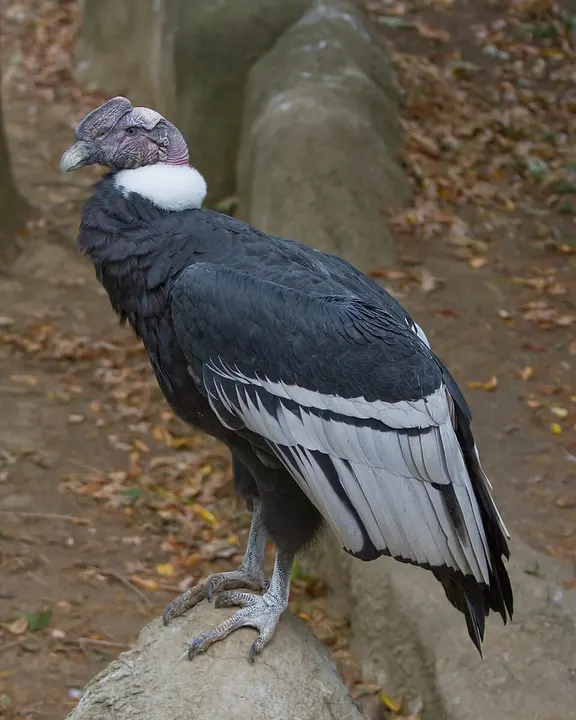
The Andean condor is a South American New World vulture and is the only extant member of the genus Vultur. It is found in the Andes mountains and adjacent Pacific coasts of western South America. With a maximum wingspan of 3.3 m and weight of 15 kg (33 lb), the Andean condor is one of the largest flying birds in the world, and is generally considered to be the largest bird of prey in the world.
One of two species commonly referred to as condors, it is a large black vulture with a ruff of white feathers surrounding the base of the neck and, especially in the male, large white patches on the wings. The head and neck are nearly featherless, and are a dull red color, which may flush and therefore change color in response to the bird's emotional state. In the male, there is a wattle on the neck and a large, dark red comb or caruncle on the crown of the head. The female condor is smaller than the male, an exception to the usual sexual dimorphism seen in birds of prey. The condor is primarily a scavenger, feeding on carrion. It prefers large carcasses, such as those of deer or cattle.
Appearance
The overall length of the Andean condor can range from 100–130 cm (3 ft 3 in – 4 ft 3 in). Among standard measurements, the wing chord is 75.7–85.2 cm (29.8–33.5 in), the tail is 33–38 cm (13–15 in) and the tarsus is 11.5–12.5 cm (4.5–4.9 in). Measurements are usually taken from specimens reared in captivity. The mean weight is 11.3 kg (25 lb), with the males averaging about a kilogram more at 12.5 kg (28 lb), the females two kilograms less at 10.1 kg (22 lb).
Behaviour
The condor soars with its wings held horizontally and its primary feathers bent upwards at the tips. The lack of a large sternum to anchor its correspondingly large flight muscles physiologically identifies it as primarily being a soarer. It flaps its wings on rising from the ground, but after attaining a moderate elevation it flaps its wings very rarely, relying on thermals to stay aloft.
Diet
The Andean condor is a scavenger, feeding mainly on carrion. Wild condors inhabit large territories, often traveling more than 200 km (120 mi) a day in search of carrion. In inland areas, they prefer large carcasses. Naturally, they feed on the largest carcasses available, which can include llamas (Lama glama), alpacas (Lama pacos), rheas (Rhea ssp.), guanacos (Lama guanicoe), deer and armadillos.
Habitat
The Andean condor is found in South America in the Andes and the Santa Marta Mountains. In the north, its present range begins in Venezuela and Colombia, where it is extremely rare, then continues south along the Andes in Ecuador, Peru, and Chile, through Bolivia and western Argentina to the Tierra del Fuego.
Where the Andean condor lives
Recorded in Argentina, Chile, Ecuador, Peru, Colombia and Bolivia (South America).
Most records fall in Región Metropolitana de Santiago, Magallanes y Antártica Chilena, Tungurahua, Pichincha, Santa Cruz and Córdoba.
See the Andean condor’s range on the globe
Conservation status
Vulnerable (VU). At risk: it could become endangered. Categories are the IUCN Red List as republished by GBIF.
Sources
The range is a density of 93,077 georeferenced GBIF records, shown on the continents where it is mainly recorded, not an expert-drawn map. Description from Wikipedia.