Animals / Bird
American robin
Turdus migratorius · Turdidae
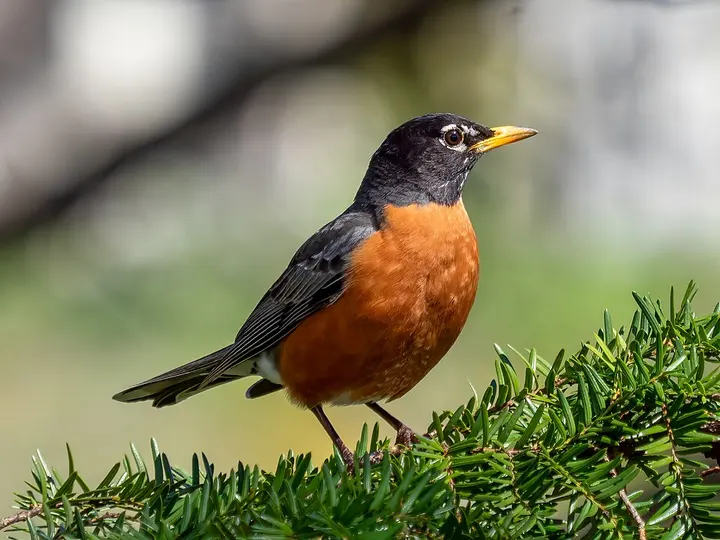
The American robin is a migratory bird of the true thrush genus and Turdidae, the wider thrush family. It is named after the European robin because of its reddish-orange breast, though the two species are not closely related, with the European robin belonging to the Old World flycatcher family. The American robin is widely distributed throughout North America, wintering from southern Canada to central Mexico and along the Pacific coast.
According to the Partners in Flight database (2019), the American robin is the most abundant landbird in North America (with 370 million individuals), ahead of red-winged blackbirds, introduced European starlings, mourning doves and house finches. It has seven subspecies. The species is active mostly during the day and assembles in large flocks at night. Its diet consists of invertebrates (such as beetle grubs, earthworms, and caterpillars), fruits, and berries. It is one of the earliest bird species to lay its eggs, beginning to breed shortly after returning to its summer range from its winter range. The robin's nest consists of long coarse grass, twigs, paper, and feathers and is smeared with mud and often cushioned with grass or other soft materials.
Appearance
The eastern subspecies (T. m. migratorius) is 23 to 28 cm (9.1 to 11.0 in) long with a wingspan ranging from 31 to 41 cm (12 to 16 in), with similar size ranges across all subspecies. The species averages about 77 g (2.7 oz) in weight, with males ranging from 72 to 94 g (2.5 to 3.3 oz) and females ranging from 59 to 91 g (2.1 to 3.2 oz).
Behaviour
The American robin is active mostly during the day, and on its winter grounds, it assembles in large flocks at night to roost in trees in secluded swamps or dense vegetation. The flocks break up during the day when the birds feed on fruits and berries in smaller groups. During the summer, males defend a breeding territory and are less social.
Diet
The diet generally consists of around 40 percent small invertebrates (mainly insects), such as earthworms, beetle grubs, caterpillars, and grasshoppers, and 60 percent wild and cultivated fruits and berries. Their ability to switch to berries allows them to winter much farther north than most other North American thrushes.
Habitat
The species breeds throughout most of North America, from Alaska and Canada southward to northern Florida and Mexico. While robins occasionally overwinter in the northern part of the United States and southern Canada, most migrate to winter south of Canada from Florida and the Gulf Coast to central Mexico, as well as along the Pacific Coast. Most depart south by the end of August and begin to return north in February and March (exact dates vary with latitude and climate).
Where the American robin lives
Recorded in United States of America and Canada (North America).
Most records fall in New York, Ontario, Pennsylvania, Québec, California and Ohio.
See the American robin’s range on the globe
Conservation status
Least concern (LC). Not at risk: it is doing well in the wild. Categories are the IUCN Red List as republished by GBIF.
Sources
The range is a density of 29,433,054 georeferenced GBIF records, shown on the continents where it is mainly recorded, not an expert-drawn map. Description from Wikipedia.