Animals / Mammal
American pika
Ochotona princeps · Ochotonidae
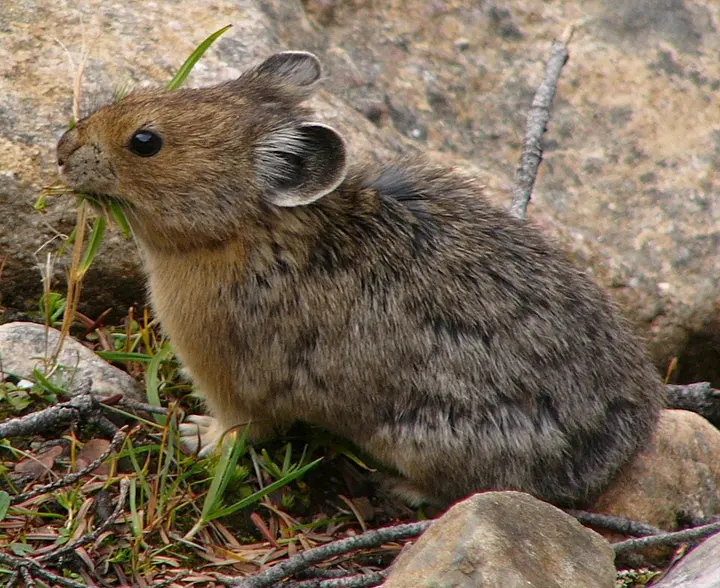
The American pika is a small, herbivorous mammal of the family Ochotonidae, closely related to rabbits and hares. It is native to the mountainous regions of western North America, typically inhabiting rocky slopes and talus fields at or above the tree line higher elevation. Unlike most mammals of similar size, the American pika is diurnal, being active primarily during the day.
It employs two distinct foraging strategies: directly consuming vegetation or gathering and storing plant materials in "haypiles" to sustain itself through the winter months, a behavior known as haying. Pikas are vocal animals, using a variety of calls and songs both to warn of approaching predators and during the breeding season. Predators of the American pika include eagles, hawks, coyotes, bobcats, foxes, and weasels. Recent studies suggest that populations in the southwestern United States are declining due to habitat loss and global warming. Despite these regional declines, the American pika is overall assessed as a species of Least Concern by the IUCN and remains common in the northwestern United States and Canada.
Appearance
American pikas, historically known as "little chief hares", is a small, rounded mammal with a compact, ovate body adapted for life in cold alpine environments. Adults typically measure 16.2 to 21.6 cm (6.4 to 8.5 in) in length, with hind feet ranging from 2.5 to 3.5 cm (0.98 to 1.38 in). They usually weigh between 121 and 176 g (4.3–6.2 oz), though body size varies among populations and regions. In some areas, males are slightly larger than females.
Diet
The American pika is a generalist herbivore, consuming a wide range of green vegetation, including various grasses, sedges, thistles, and fireweed. Although pikas can meet their water requirements through moisture in plants, they will drink water when it is available. American pikas use two foraging strategies: direct consumption of food (feeding) and caching vegetation in "haypiles" for winter use (haying).
Habitat
The American pika is found throughout the mountainous regions of western North America, ranging from central British Columbia and Alberta in Canada to the U.S. states of Oregon, Washington, Idaho, Montana, Wyoming, Colorado, Utah, Nevada, California, and New Mexico. Of the approximately 30 existing species of pika, it is one of only two native to North America, the other being the collared pika (O. collaris).
Life cycle
Adult males and females with adjacent territories form mated pairs. When multiple males are present, females exhibit mate choice. The species is a reflex ovulator—ovulation occurs only after copulation—and is also seasonally polyestrous. Females typically produce two litters per year, with each litter averaging three young. Breeding begins roughly one month before snowmelt, and gestation lasts around 30 days.
Where the American pika lives
Recorded in United States of America and Canada (North America).
Most records fall in Colorado, Washington, California, British Columbia, Utah and Wyoming.
See the American pika’s range on the globe
Conservation status
Least concern (LC). Not at risk: it is doing well in the wild. Categories are the IUCN Red List as republished by GBIF.
Sources
The range is a density of 16,918 georeferenced GBIF records, shown on the continents where it is mainly recorded, not an expert-drawn map. Description from Wikipedia.