Animals / Crustacean
American lobster
Homarus americanus · Nephropidae
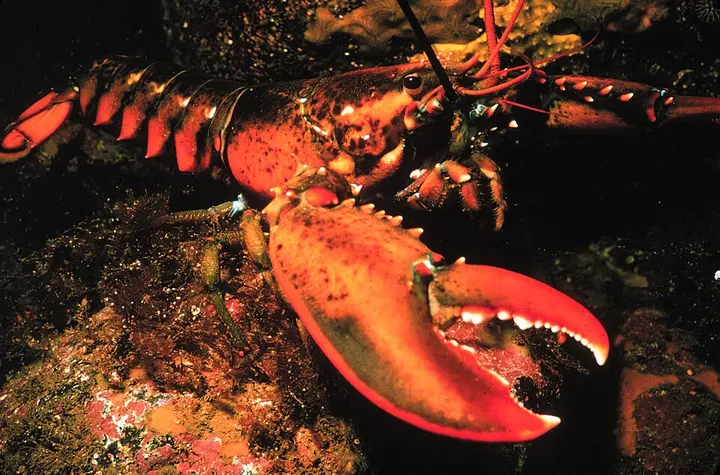
The American lobster is a species of lobster found on the Atlantic coast of North America, chiefly from Labrador to New Jersey. It is also known as Atlantic lobster, Canadian lobster, northern lobster, Canadian Reds, or Maine lobster. It is sometimes called the true lobster or common lobster, but those names are ambiguous.
It can reach a body length of 64 cm (25 in), and a mass of over 20 kilograms (44 lb), making it not only the heaviest crustacean in the world, but also the heaviest of all living arthropod species. Its closest relative is the European lobster Homarus gammarus, which can be distinguished by its coloration and the lack of spines on the underside of the rostrum. American lobsters are usually bluish green to brown with red spines, but several color variations have been observed.
Appearance
Homarus americanus commonly reaches 200–610 millimetres (8–24 in) long and weighs 0.45–4.08 kilograms (1–9 lb) in weight, but has been known to weigh as much as 20 kg (44 lb), making this the heaviest crustacean in the world. Together with Sagmariasus verreauxi, it is also the longest decapod crustacean in the world; an average adult is about 230 mm (9 in) long and weighs 680 to 910 g (1.5 to 2 lb).
Behaviour
The American lobster thrives in cold, shallow waters where there are many rocks and other places to hide from predators. It typically lives at a depth of 4–50 m (13–164 ft), but can be found up to 480 m (1,570 ft) below the surface.
Diet
The natural diet of H. americanus is relatively consistent across different habitats. It is dominated by mollusks (especially mussels, clams and snails), echinoderms and polychaetes, although a wide range of other prey items may be eaten, including other crustaceans (such as crabs), brittle stars, cnidarians and small fish. It will also feed on dead animals, as well as algae and eelgrass.
Habitat
Homarus americanus is distributed along the Atlantic coast of North America, from Labrador in the north to Cape Hatteras, North Carolina, in the south. South of New Jersey, the species is uncommon, and landings in Delaware, Maryland, Virginia and North Carolina usually make up less than 0.1% of all landings. A fossil claw assigned to Homarus americanus was found at Nantucket, dating from the Pleistocene.
Life cycle
Mating only takes place shortly after the female has molted and her exoskeleton is still soft. The female releases a pheromone which causes the males to become less aggressive and to begin courtship, which involves a courtship dance with claws closed. Eventually, the male inserts spermatophores (sperm packets) into the female's seminal receptacle using his first pleopods; the female may store the sperm for up to 15 months.
Where the American lobster lives
Recorded in Canada and United States of America (North America).
Most records fall in Nova Scotia, New Brunswick, Nunavut, Maine, Massachusetts and Prince Edward Island.
See the American lobster’s range on the globe
Conservation status
Least concern (LC). Not at risk: it is doing well in the wild. Categories are the IUCN Red List as republished by GBIF.
Sources
The range is a density of 887,431 georeferenced GBIF records, shown on the continents where it is mainly recorded, not an expert-drawn map. Description from Wikipedia.