Animals / Bird
American kestrel
Falco sparverius · Falconidae
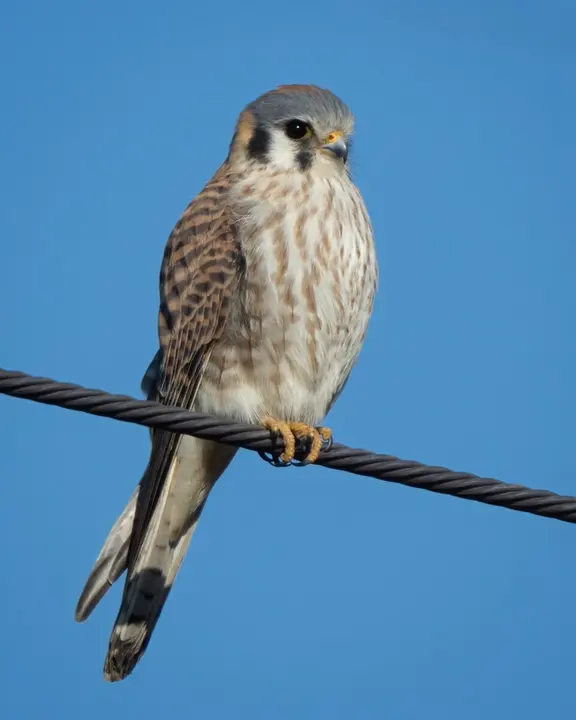
The American kestrel is the smallest and most common falcon in the Americas. Though it has been called the American "sparrow hawk", this now obsolete vernacular name is a misnomer; the American kestrel is a true falcon, while neither the Eurasian sparrowhawk nor the other species called sparrowhawks are in the family Falconidae, hence only very distantly related to the American kestrel. It has a roughly two-to-one range in size over subspecies and sex, varying in size from about the weight of a blue jay to a mourning dove.
It is a very successful species, occurring almost throughout North and South America except for the Arctic fringes of North America, and the densest tropical Amazon rainforest areas; it has evolved into 17 subspecies adapted to different environments and habitats throughout the region. It exhibits sexual dimorphism in size (females being moderately larger) and plumage, although both sexes have a rufous back with noticeable barring. Its plumage is colorful, and juveniles are similar in plumage to adults. The American kestrel usually hunts in an energy-conserving fashion by perching and scanning the ground for prey to ambush, though it also hunts from the air. It sometimes hovers in the air with rapid wing beats while homing in on prey.
Appearance
Under traditional terminology, the American kestrel is the smallest raptor in the Americas, though the South American spot-winged falconet is almost as small. The American kestrel is sexually dimorphic, although there is some overlap in plumage coloration between the sexes. The bird ranges from 22 to 31 cm (8.7 to 12.2 in) in length with a wingspan of 51–61 cm (20–24 in).
Behaviour
The American kestrel has three basic vocalizations – the "klee" or "killy", the "whine", and the "chitter". The "klee" is usually delivered as a rapid series – klee, klee, klee, klee when the kestrel is upset or excited. This call is used in a wide variety of situations and is heard from both sexes, but the larger females typically have lower-pitched voices than the males. The "whine" call is primarily associated with feeding but is also uttered during copulation.
Diet
American kestrels feed largely on small animals such as grasshoppers, crickets, butterflies, moths, dragonflies, beetles, lizards, mice, voles, shrews, frogs, and small birds. The kestrel has also been reported to have killed scorpions, snakes, bats, and squirrels. The kestrel is able to maintain high population densities, at least in part because of the broad scope of its diet. The American kestrel's primary mode of hunting is by perching and waiting for prey to come near.
Life cycle
American kestrels are sexually mature by their first spring. In migratory populations, the males arrive at the breeding ground before females, then the female selects a mate. Pair bonds are strong, often permanent. Pairs usually use previous nesting sites in consecutive years. This gives birds an advantage over younger or invading individuals, as they would already be familiar with the hunting grounds, neighbors, predators, and other features of the site.
Where the American kestrel lives
Recorded in United States of America, Canada, Mexico and Argentina (North America and South America).
Most records fall in California, Texas, Florida, Colorado, Arizona and Oregon.
See the American kestrel’s range on the globe
Conservation status
Least concern (LC). Not at risk: it is doing well in the wild. Categories are the IUCN Red List as republished by GBIF.
Sources
The range is a density of 5,948,623 georeferenced GBIF records, shown on the continents where it is mainly recorded, not an expert-drawn map. Description from Wikipedia.