Animals / Amphibian
American green tree frog
Dryophytes cinereus · Hylidae
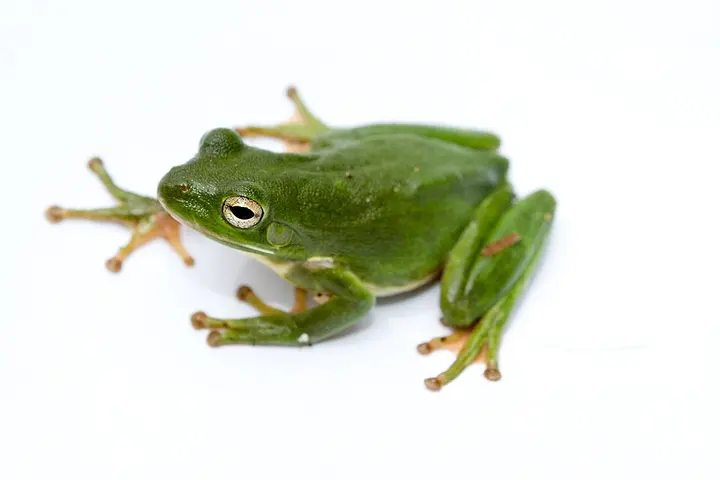
The American green tree frog is a common arboreal species of New World tree frog belonging to the family Hylidae. This nocturnal insectivore is moderately sized and has a bright green to reddish-brown coloration. Sometimes, light yellowish spots are present on the dorsum.
Commonly found in the central and southeastern United States, the frog lives in open canopy forests with permanent water sources and abundant vegetation. The American green tree frog is strictly aquatic during the hibernating and mating seasons. When defending its territory, the frog either emits aggressive call signals or resolves to grapple with intruders, seldom leading to injury or death. To avoid predation, the frog will leap into the water or jump into the treetops. Female green tree frogs are larger than males. Body size is often a critical determinant of competitive ability and reproductive behavior. Pairs breed through amplexus. Males emit low frequency advertisement calls to attract females.
Appearance
The American green tree frog is moderately sized. It has long legs, a streamlined and slender build, and smooth skin. It has large, protruding eyes with horizontal pupils. The American green tree frog ranges from 3.2 to 6.4 centimetres (1+1⁄4 to 2+1⁄2 in) in length. For perspective on the growth of juveniles, recently metamorphosed "young-of-the-year" were found to be about 20.6 mm. Once grown, individuals reach sexual maturity within a year.
Behaviour
Because the species is small and easily frightened, they often do not do well with frequent handling. Some specimens do seem to tolerate it occasionally, so handling frequency should be determined on an individual basis. The American green tree frog tends to be nocturnal, so they will be most active once the lights are off. They are arboreal (tree-dwelling) and will commonly be found clinging to vertical surfaces using their toe pads.
Habitat
The American green tree frog is found in the central and southeastern United States with a geographic range from the Eastern Shore of Maryland to southeast Florida with populations as far west as central Texas and as far north as Delaware and southern New Jersey, though the size of its distribution may be larger or vary seasonally. They are indigenous to the coastal plains of North Carolina, South Carolina, Georgia, and all of Florida.
Life cycle
Most American green tree frog females breed once per year, but some have multiple clutches in a single mating season. In a Florida population, "advertisement calls of males were documented between March and September and pairs in amplexus were observed between April and August". The average number of eggs in a single clutch was observed to be about 400 for this specific population. In a population in Florida where conditions were better, clutch size averaged over 1,200.
Where the American green tree frog lives
Recorded in United States of America (North America).
Most records fall in Texas, Florida, North Carolina, Georgia, Virginia and Alabama.
See the American green tree frog’s range on the globe
Conservation status
Least concern (LC). Not at risk: it is doing well in the wild. Categories are the IUCN Red List as republished by GBIF.
Sources
The range is a density of 53,924 georeferenced GBIF records, shown on the continents where it is mainly recorded, not an expert-drawn map. Description from Wikipedia.