Animals / Bird
American crow
Corvus brachyrhynchos · Corvidae
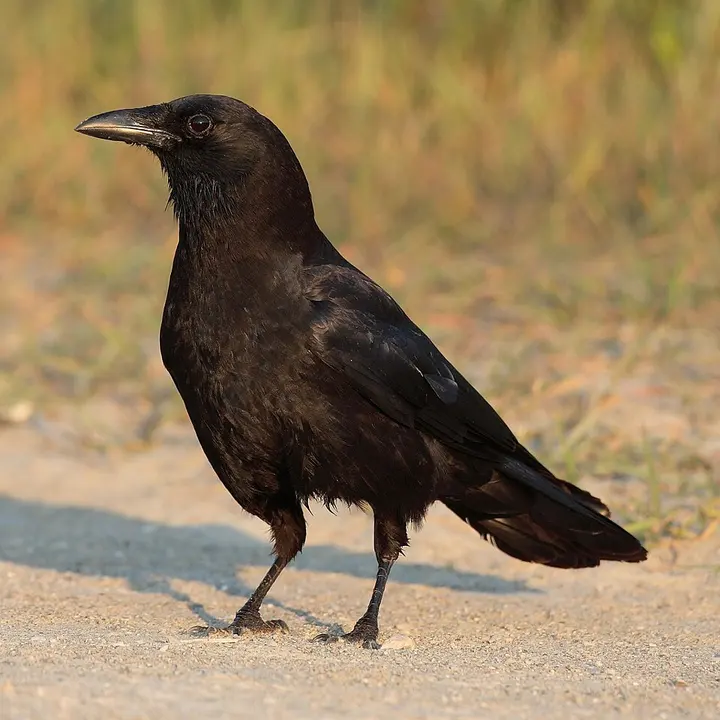
The American crow is a large passerine bird species of the family Corvidae. It is a common bird found throughout much of North America, only absent from the tundra biome. The American crow is the New World counterpart to the carrion crow and the hooded crow of Eurasia, occupying similar ecological niches.
The American crow has all-black plumage, with iridescent feathers. It looks similar to other all-black corvids. It is highly intelligent, similar to other Corvidae, and is adaptable to human environments. The American crow can be distinguished from the common raven by its smaller size and a slightly less pronounced beak, and from the carrion crow by its size, as the carrion crow is larger and of a stockier build. The American crow can be difficult to distinguish from the fish crow; however, the fish crow tends to fluff its throat feathers when calling. The American crow is an omnivore, feeding on insects, seeds, and nuts while also preying on small animals.
Appearance
The American crow is a large, distinctive bird with iridescent black feathers all over. Its legs, feet, and bill are also black. They measure 40–53 cm (16–21 in) in length, of which the tail makes up about 40%. The wing chord is 24.5 to 33 cm (9.6 to 13.0 in), with the wingspan ranging from 85 to 100 cm (33 to 39 in). The bill length can be from 3 to 5.5 cm (1.2 to 2.2 in), varying strongly according to location.
Behaviour
Studying the behavior of American crows is laborious due to the difficulty in catching them, resulting in much of their behavior, including daily routine, migration, molting, survivorship, age of first breeding, nestling development, and the nature of nesting helpers, being poorly studied.
Diet
The American crow is omnivorous. It will feed on invertebrates of all types, carrion, scraps of human food, fruits, nuts such as walnuts and almonds, seeds, eggs and nestlings, stranded fish on the shore, and various grains. American crows are active hunters and will prey on mice, young rabbits, frogs, and other small animals. In the winter and autumn, the diet of American crows is more dependent on nuts and acorns. Occasionally, they will visit bird feeders.
Habitat
The American crow has a large range, extending from the Pacific Ocean to the Atlantic Ocean in Canada, on the French islands of Saint-Pierre and Miquelon, south through the United States, and into northern Mexico. They have also been recorded in Bermuda from 1876 onwards.
Life cycle
American crows are socially monogamous cooperative breeding birds. Mated pairs form large families of up to 15 individuals from several breeding seasons that remain together for many years. Offspring from a previous nesting season will usually remain with the family to assist in rearing new nestlings. American crows do not reach breeding age for at least two years. Most do not leave the nest to breed for four to five years.
Where the American crow lives
Recorded in United States of America and Canada (North America).
Most records fall in California, Québec, Ontario, New York, Pennsylvania and Washington.
See the American crow’s range on the globe
Conservation status
Least concern (LC). Not at risk: it is doing well in the wild. Categories are the IUCN Red List as republished by GBIF.
Sources
The range is a density of 29,095,040 georeferenced GBIF records, shown on the continents where it is mainly recorded, not an expert-drawn map. Description from Wikipedia.