Animals / Bird
American bushtit
Psaltriparus minimus · Aegithalidae
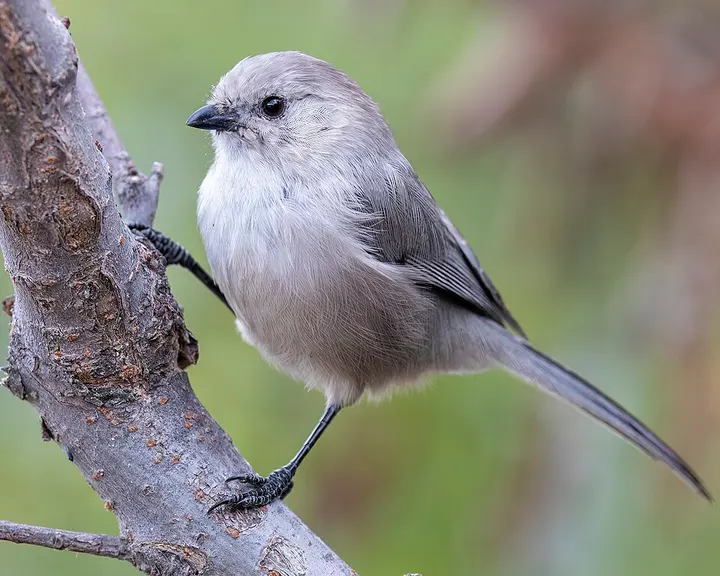
The American bushtit, or simply bushtit, is a social songbird belonging to the monotypic genus Psaltriparus. It is one of the smallest passerines in North America and it is the only species in the family Aegithalidae found in the Americas; the other eleven species occur in Eurasia.
The American bushtit's distinguishing characteristics are its tiny size, its plump and large head, and its long tail. Its range stretches from Vancouver in Canada, south through the Western United States, via the Great Basin, the lowlands and foothills of California, the highlands of Mexico, to Guatemala. Bushtits usually inhabit mixed open woodlands, which contains oaks and a scrubby chaparral understory. They can also be found residing in gardens and parks. Their food source is small insects, primarily, and spiders in mixed-species feeding flocks. The sharp-shinned hawk and other raptors prey upon American bushtits. Bushtits live in flocks of 10 to 40 birds and family members sleep together in their large, hanging nest during breeding season.
Appearance
With a length of 100–110 mm (3.9–4.3 in) and a weight of 4.5–6 g (0.16–0.21 oz), the American bushtit is one of the smallest passerines in North America. It is mostly gray-brown, with a large head, short neck, long tail, and small, stubby beak. American bushtits have different characteristics based on their sex and habitats. The male has dark brown to black eyes while the adult female has yellow eyes.
Behaviour
Bushtits usually inhabit mixed open woodlands, which contains oaks and a scrubby chaparral understory. It can also be found residing in gardens and parks. It lives under the highland parts of Mexico and the western United States to Vancouver, via the Great Basin, the lowlands and foothills of California, southern Mexico, and Guatemala. The American bushtit has an active and social demeanor.
Life cycle
Female bushtits lay plain white oval eggs in batches of 4-10, but both parents share the responsibility of incubation for 11–13 days. The egg is 13.7 mm long and 10 mm wide. Once the chicks hatch, both the male and female bushtits cooperate to feed and care for them for 14–18 days. They can raise 1-2 broods a year, and older siblings from the first brood may assist in feeding the next.
Where the American bushtit lives
Recorded in United States of America, Canada and Mexico (North America).
Most records fall in California, Oregon, Washington, British Columbia, Colorado and New Mexico.
See the American bushtit’s range on the globe
Conservation status
Least concern (LC). Not at risk: it is doing well in the wild. Categories are the IUCN Red List as republished by GBIF.
Sources
The range is a density of 2,554,162 georeferenced GBIF records, shown on the continents where it is mainly recorded, not an expert-drawn map. Description from Wikipedia.