Animals / Mammal
American black bear
Ursus americanus · Ursidae
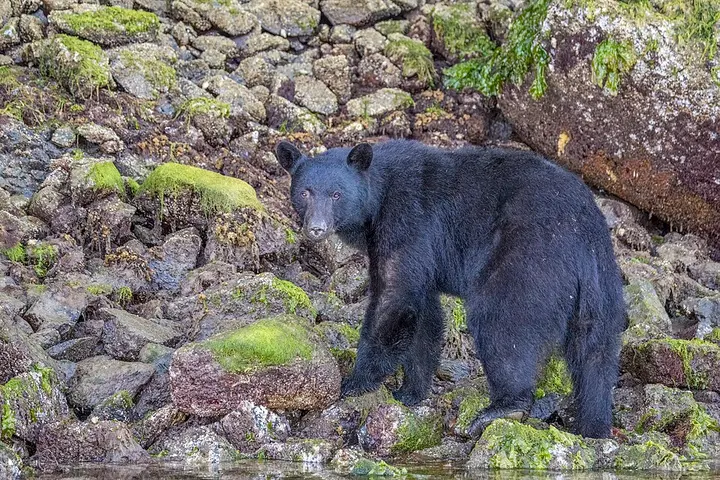
The American black bear, or simply black bear, is a species of medium-sized bear which is endemic to North America. It is the continent's smallest and most widely distributed bear species. It is an omnivore, with a diet varying greatly depending on season and location.
It primarily inhabits forested regions, but may venture beyond forest boundaries in search of food. Individuals are occasionally drawn to human settlements due to the availability of easily accessible food sources. The International Union for Conservation of Nature (IUCN) lists the American black bear as a least-concern species because of its widespread distribution and a large population, estimated to be twice that of all other bear species combined. Along with the brown bear (Ursus arctos), it is one of the two modern bear species not considered by the IUCN to be globally threatened with extinction.
Appearance
The skulls of American black bears are broad, with narrow muzzles and large jaw hinges. In Virginia, the length of adult bear skulls was found to average 26.2 to 31.7 cm (10.3 to 12.5 in). Across its range, the longest reported skull measured from 23.5 to 35 cm (9.3 to 13.8 in). Sexual dimorphism can be seen in the tendency for females to have slenderer and more pointed faces, and conversely, for larger cheek teeth in males.
Diet
The hunting of American black bears has taken place since the initial peopling of the Americas. The first piece of evidence dates to a Clovis site at Lehner Ranch, Arizona. Partially calcined teeth of a 3-month old black bear cub came from a roasting pit, suggesting the bear cub was eaten. The surrounding charcoal was dated to the Early Holocene (10,940 BP). Black bear remains also appear to be associated with early peoples in Tlapacoya, Mexico.
Habitat
Throughout their range, habitats preferred by American black bears have a few shared characteristics. They are often found in areas with relatively inaccessible terrain, thick understory vegetation and large quantities of edible material (especially masts).
Life cycle
Sows usually produce their first litter at the age of 3 to 5 years, with those living in more developed areas tending to get pregnant at younger ages. The breeding period usually occurs in the June–July period, though it can extend to August in the species' northern range. The breeding period lasts for two to three months. Both sexes are promiscuous.
Where the American black bear lives
Recorded in United States of America, Canada and Mexico (North America).
Most records fall in British Columbia, California, Ontario, North Carolina, New York and Alaska.
See the American black bear’s range on the globe
Conservation status
Least concern (LC). Not at risk: it is doing well in the wild. Categories are the IUCN Red List as republished by GBIF.
Sources
The range is a density of 59,360 georeferenced GBIF records, shown on the continents where it is mainly recorded, not an expert-drawn map. Description from Wikipedia.