Animals / Mammal
American bison
Bison bison · Bovidae
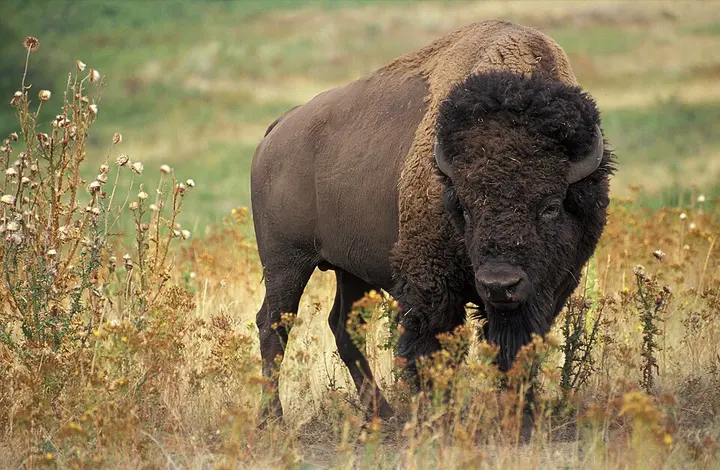
The American bison, commonly known as the American buffalo, or simply buffalo, is a species of bison that is endemic to North America. It is one of two extant species of bison, along with the European bison. Its historical range circa 9000 BC is referred to as the great bison belt, a tract of rich grassland spanning from Alaska south to the Gulf of Mexico, and east to the Atlantic Seaboard, as far north as New York, south to Georgia, and according to some sources, further south to northern Florida, with sightings in North Carolina near Buffalo Ford on the Catawba River as late as 1750.
Two subspecies or ecotypes have been described: the plains bison (B. b. bison), smaller and with a more rounded hump; and the wood bison (B. b. athabascae), the larger of the two and having a taller, square hump. There has been a proposal to divide the plains bison into subspecies of northern (B. b. montanae) and southern (B. b. bison), but this proposal has limited scientific support. The wood bison is one of the largest wild species of extant bovid in the world, surpassed only by the Asian gaur. With wild animals weighing up to 1,270 kg (2,800 lb), the bison is among the heaviest extant land animals in North America and the heaviest herbivore.
Appearance
A bison has a shaggy, long, dark-brown winter coat, and a lighter-weight, lighter-brown summer coat. Male bison are significantly larger and heavier than females. Plains bison are often in the smaller range of sizes, and wood bison in the larger range. Head-rump lengths at maximum up to 3.5 m (11 ft 6 in) for males and 2.85 m (9 ft 4 in) for females long and the tail adding 30 to 95 cm (1 ft 0 in to 3 ft 1 in).
Behaviour
Bison are migratory and herd migrations can be directional as well as altitudinal in some areas. Bison have usual daily movements between foraging sites during the summer. In the Hayden Valley, Wyoming, bison have been recorded traveling, on average, 3 km (2 mi) per day. The summer ranges of bison appear to be influenced by seasonal vegetation changes, interspersion and size of foraging sites, the rut, and the number of biting insects.
Diet
Buffalo hunting, i.e. hunting of the American bison, was an activity fundamental to the Indigenous peoples of the Great Plains, providing more than 150 uses for all parts of the animal, including being a major food source, hides for clothing and shelter, bones and horns as tools as well as ceremonial and adornment uses.
Where the American bison lives
Recorded in United States of America and Canada (North America).
Most records fall in Wyoming, South Dakota, Utah, Alberta, North Dakota and Colorado.
See the American bison’s range on the globe
Conservation status
Near threatened (NT). Not at risk yet, but could be soon. Categories are the IUCN Red List as republished by GBIF.
Sources
The range is a density of 22,748 georeferenced GBIF records, shown on the continents where it is mainly recorded, not an expert-drawn map. Description from Wikipedia.