Animals / Mammal
Alpine ibex
Capra ibex · Bovidae
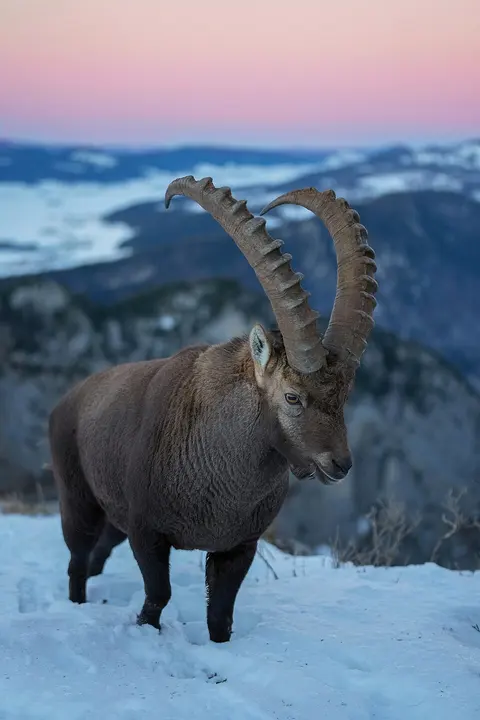
The Alpine ibex, also known as the steinbock, is a European species of goat which lives in the Alps. It is one of ten species in the genus Capra, and its closest living relative is the Iberian ibex. The Alpine ibex is a sexually dimorphic species; males are much larger and carry much larger, longer horns than females.
Its coat is brownish-grey. Alpine ibexes tend to live in steep, rough terrain and open alpine meadows. They can be found at elevations as high as 3,300 m (10,800 ft) and their sharp hooves allow them to scale the steep slopes and cliffs of their mountainous habitat. Alpine ibexes primarily feed on grass and are active throughout the year. Although they are social animals, adult males and females segregate for most of the year, coming together only to mate. During the breeding season, males use their long horns to fight for access to females. Ibexes have few predators but may succumb to parasites and diseases. By the 19th century, human hunters extirpated the Alpine ibex from most of its range, driving it near to extinction.
Appearance
Alpine ibexes are sexually dimorphic. Males grow to a height of 90 to 101 cm (35 to 40 in) at the withers with a body length of 149–171 cm (59–67 in) and weigh 67–117 kg (148–258 lb). Females are much smaller and have a shoulder height of 73–84 cm (29–33 in), a body length of 121–141 cm (48–56 in), and weigh 17–32 kg (37–71 lb). The Alpine ibex is a stocky animal with a tough neck and robust legs with short metapodials.
Behaviour
The Alpine ibex is strictly herbivorous. Its diet consists mostly of grass, which is preferred all year; during the summer, ibexes supplement their diet with herbs, while during autumn and winter they also eat dwarf shrubs and conifer shoots. The most-commonly eaten grass genera are Agrostis, Avena, Calamagrostis, Festuca, Phleum, Poa, Sesleria, and Trisetum.
Habitat
The Alpine ibex is native to the Alps of central Europe; its range includes France, Switzerland, Liechtenstein, Italy, Germany, and Austria. Fossils of the species have been found as far south as Greece, where it became locally extinct about 7,500 years ago due to human predation. Between the 16th and 18th centuries, the species disappeared from much of its range due to hunting, leaving by the 19th century one surviving population in and around Gran Paradiso, Italy.
Where the Alpine ibex lives
Recorded in France, Switzerland and Italy (Europe).
Most records fall in Savoie, Hautes-Alpes, Graubünden, Valais, Isère and Vaud.
See the Alpine ibex’s range on the globe
Conservation status
Least concern (LC). Not at risk: it is doing well in the wild. Categories are the IUCN Red List as republished by GBIF.
Sources
The range is a density of 182,181 georeferenced GBIF records, shown on the continents where it is mainly recorded, not an expert-drawn map. Description from Wikipedia.