Animals / Reptile
Aldabra giant tortoise
Aldabrachelys gigantea · Testudinidae
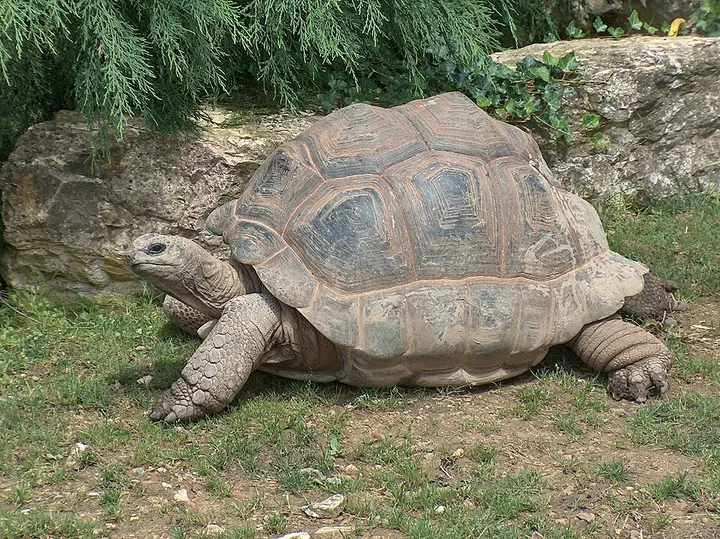
The Aldabra giant tortoise, Aldabra tortoise, or simply giant tortoise, is a species of tortoise in the family Testudinidae and genus Aldabrachelys. The species is endemic to the Seychelles, with the nominate subspecies, A. g. gigantea native to Aldabra atoll. It is one of the largest tortoises in the world.
Historically, giant tortoises were found on many of the western Indian Ocean islands, as well as Madagascar, and the fossil record indicates giant tortoises once occurred on every continent and many islands with the exception of Antarctica. Many of the Indian Ocean species were thought to be driven to extinction by over-exploitation by European sailors, and they were all seemingly extinct by 1840 with the exception of the Aldabran giant tortoise on the island atoll of Aldabra. Although some remnant individuals of A. g. hololissa and A. g. arnoldi may remain in captivity, in recent times, these have all been reduced as subspecies of A. gigantea.
Appearance
The carapace of A. gigantea is a brown or tan in color with a high, domed shape. The species has stocky, heavily scaled legs to support its heavy body. The neck of the Aldabra giant tortoise is very long, even for its great size, which helps the animal to exploit tree branches up to a meter from the ground as a food source. Similar in size to the famous Galápagos giant tortoise, its carapace averages 122 cm (48 in) in length. Males have an average weight of 250 kg (550 lb).
Behaviour
A peculiar habitat has coevolved due to the grazing pressures of the tortoises: "tortoise turf", a comingling of 20+ species of grasses and herbs. Many of these distinct plants are naturally dwarfed and grow their seeds not from the tops of the plants, but closer to the ground to avoid the tortoises' close-cropping jaws. As the largest animal in its environment, the Aldabra tortoise performs a role similar to that of the elephant.
Diet
Primarily herbivores, Aldabra giant tortoises eat grasses, leaves, woody plant stems, and fruit. They occasionally indulge in small invertebrates and carrion, even eating the bodies of other dead tortoises. In captivity, Aldabra giant tortoises are known to consume fruits, such as apples and bananas, as well as compressed vegetable pellets.
Habitat
A peculiar habitat has coevolved due to the grazing pressures of the tortoises: "tortoise turf", a comingling of 20+ species of grasses and herbs. Many of these distinct plants are naturally dwarfed and grow their seeds not from the tops of the plants, but closer to the ground to avoid the tortoises' close-cropping jaws. As the largest animal in its environment, the Aldabra tortoise performs a role similar to that of the elephant.
Where the Aldabra giant tortoise lives
Recorded in Seychelles (Seven seas (open ocean) and Africa).
Introduced, not native, in Tanzania, Mauritius and Saint Helena.
Most records fall in Baie Sainte Anne, Grand'Anse Praslin, Zanzibar West, Outer Islands, Zanzibar South and Central and Rivière Noire.
See the Aldabra giant tortoise’s range on the globe
Conservation status
Vulnerable (VU). At risk: it could become endangered. Categories are the IUCN Red List as republished by GBIF.
Sources
The range is a density of 467 georeferenced GBIF records, shown on the continents where it is mainly recorded, not an expert-drawn map. Description from Wikipedia.