Animals / Mammal
African wild dog
Lycaon pictus · Canidae
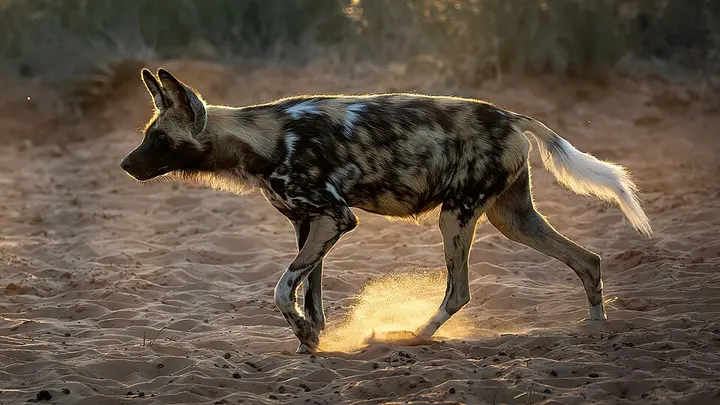
The African wild dog, also called painted dog and Cape hunting dog, is a wild canine native to sub-Saharan Africa. It is the largest wild canine in Africa and the only extant member of the genus Lycaon, which is distinguished from Canis by dentition highly specialised for a hypercarnivorous diet and by a lack of dewclaws.
An estimated 6,600 adults (including 1,400 mature individuals) live in 39 subpopulations, all threatened by habitat fragmentation, human persecution, and outbreaks of disease. As the largest subpopulation probably consists of fewer than 250 individuals, the African wild dog has been listed as endangered on the IUCN Red List since 1990. The African wild dog is a specialized hunter of terrestrial ungulates, mostly hunting at dawn and dusk, but it also displays diurnal activity. It captures its prey by using stamina and cooperative hunting to exhaust them. Its natural competitors are lions and spotted hyenas; the former kill the dogs where possible, whilst the latter are frequent kleptoparasites.
Appearance
The African wild dog is the bulkiest and most solidly built of African canids. The species stands 60 to 75 cm (24 to 30 in) at the shoulders, measures 71 to 112 cm (28 to 44 in) in head-and-body length, and has a tail length of 29 to 41 cm (11 to 16 in). Adults have a weight range of 18 to 36 kg (40 to 79 lb). Typically, dogs from East Africa weigh around 20–25 kg (44–55 lb). By body mass, they are only outsized amongst other extant canids by the wolf species complex.
Behaviour
The African wild dog have strong social bonds, stronger than those of sympatric lions and spotted hyenas; thus, solitary living and hunting are extremely rare in the species. It lives in permanent packs consisting of two to 27 adults and yearling pups. The typical pack size in the Kruger National Park and the Maasai Mara is four or five adults, while packs in Moremi and Selous Game Reserves contain eight or nine.
Habitat
The African wild dog occurs foremost in Southern and East Africa. It is rare in North Africa and mostly absent in West Africa, with the only potentially viable population occurring in Senegal's Niokolo-Koba National Park. It is occasionally sighted in other parts of Senegal, Guinea, and Mali. Its distribution is patchy in East Africa. It inhabits mostly savannas and arid zones, generally avoiding forested areas.
Where the African wild dog lives
Recorded in South Africa, Botswana, Kenya, Tanzania, Zambia, Zimbabwe and Namibia (Africa).
Most records fall in Mpumalanga, North-West, Limpopo, Rift Valley, KwaZulu-Natal and North West.
See the African wild dog’s range on the globe
Conservation status
Endangered (EN). In danger of dying out in the wild. Categories are the IUCN Red List as republished by GBIF.
Sources
The range is a density of 2,146 georeferenced GBIF records, shown on the continents where it is mainly recorded, not an expert-drawn map. Description from Wikipedia.